Upanishads classes are structured courses that introduce students to the Upanishads, the philosophical texts that form the concluding portion of the Vedas. Most classes read selected passages, explain their Sanskrit terms, discuss their historical and philosophical context, and connect the ideas to daily life. Formats vary widely. Some are live online sessions with a teacher, some are pre-recorded certificate courses, and some are academic courses with written notes and assessments. This guide explains what these classes typically cover, how the formats differ, and what to check before enrolling. Course details mentioned here were taken from providers’ pages at the time they were inspected, so schedules, fees, and batch dates should be confirmed directly with each provider.

Short answer: what is an Upanishad class?

An Upanishad class is a guided study of one or more Upanishads. Good classes do three things. They explain the text’s place within the Vedic literature, they read or recite selected passages in the original Sanskrit or in translation, and they interpret those passages through a commentary or teaching tradition. Some classes focus on a single text such as the Isha Upanishad. Others survey many texts over several months.
Readers new to the subject usually benefit most from a course that introduces the literature first, then moves to close reading. Readers who already know the basics often look for a class that follows a specific commentary tradition or covers the major texts in depth.
What the Upanishads are
Their place within the Vedas
The Upanishads are commonly described as the final part of the Vedas, which is why they are sometimes called Vedanta, a term that also refers to the later philosophical tradition built on them. The Bhishma School of Indian Knowledge Systems describes the Upanishads as part of the Vedas and as the original source of Indian Vedic philosophy in its course introduction. That description reflects a particular teaching perspective. Other academic and traditional accounts also place the Upanishads at the end of Vedic literature, but they may differ on how they describe that relationship.
The Oxford Centre for Hindu Studies course on the Vedas and Upanishads presents the two as the foundational texts of Hindu thought. Its outline says the Vedas contain hymns and ritual material, while the Upanishads form the philosophical dialogues that follow. This division is useful for beginners because it explains why a class on the Upanishads often begins with a short introduction to the Vedic hymns and rituals.
Shruti and the philosophical portion
The Chinmaya International Foundation’s course pages describe the Upanishads as the philosophical portion of the shruti, the category of texts traditionally regarded as heard or revealed. The Oxford Centre’s course outline also explains that the Veda is known as shruti, meaning that which was heard, and that tradition regards its teachings as not the work of any human author. This is a traditional view. It is a central belief for many Hindu communities, but it is not a historical claim that can be settled by manuscript evidence alone.
This distinction matters in a class. Students can learn what the texts say, how traditions understand their authority, and how modern scholars date and study them, without treating these three levels as the same thing.
What students study in Upanishad classes
Commonly listed texts
Class syllabi usually name a set of major Upanishads. The course content published by the Bhishma School includes the Isha, Kena, Katha, Prashna, Mundaka, Mandukya, Taittiriya, Aitareya, Chandogya, Brihadaranyaka, Shvetashvatara, Kaushitaki, and Maitrayani Upanishads. The Oxford Centre’s seven-week course focuses on the Brihadaranyaka, Chandogya, Katha, Isha, and Shvetashvatara Upanishads. Those lists differ because each provider chooses a scope based on the time available and the teaching goal.
Some classes also study the Upanishads through later commentaries. The Vedanta Amritam class page states that its Upanishad class will cover the ten principal Upanishads commented on by Adi Shankaracharya, along with some others. Students should understand that such a class is studying the Upanishads through a commentary tradition, not only the bare texts.
Recurring themes
Most courses return to a set of themes rather than treating each text in isolation. Commonly discussed themes include the relationship between the individual self and ultimate reality, the nature of knowledge and ignorance, the role of the teacher and student in learning, and ethical living. The Bhishma course description lists topics such as Shishya Samvad, which refers to the dialogue between teacher and disciple, and the role of Gurukul education. These are presented as course topics. A reader can verify the textual basis by reading the passages in a published edition or translation.
The Bhishma School also describes Upanishad study as addressing moral life, study, social order, governance, and environment, and it refers to a framework of Vyashti, Samashti, and Parameshti, meaning the individual, society, and universe. This is a presentation by the provider. It is a useful lens for some students, but a class that uses it should say that it is a teaching framework rather than a neutral summary of every Upanishad.
Story and dialogue
Many Upanishads are structured around dialogues, teachers, students, and short narratives. Classes often use these exchanges because they show how a question is asked and answered. This is a useful study method. A good instructor will point out where a passage is a story, where it is a teaching dialogue, and where it is a technical discussion of ritual or cosmology, because the reader’s expectations should differ in each case.
Formats of Upanishad classes
The main formats differ in pace, assessment, and the level of interaction with a teacher. The list below describes types of classes inspected in the sources, not a ranking.
- Live online study groups. The Vedanta Amritam class page describes online live sessions, with students encouraged to attend a weekly live session and use recordings for revision. Its page says courses are designed for long-term study, and that drop-in participation is not advised. Schedules and batch availability on that page are time-sensitive and must be checked before enrolling.
- Pre-recorded certificate courses. The Bhishma School’s Study of Upanishads course page describes pre-recorded content, e-books, and a certificate of participation, with the language of instruction given as Hindi. The page lists 1600 or more minutes of content. Its course page also describes a registration process that involves emailing receipt details, so students should confirm the current procedure with the provider.
- Structured academic courses. The Oxford Centre for Hindu Studies’ Vedas and Upanishads course is described as seven weeks, with weekly video lectures, 92 pages of course notes, a tutor-moderated discussion forum, optional live community sessions with affiliated scholars, and an essay assessment. The page states that no prior knowledge is needed.
- Multi-course programmes. The Chinmaya International Foundation lists an Upanishad course among its online study courses. Its navigation also lists related offerings such as Vedanta Basics, Upanishads, and Sanskrit study, which helps a student plan a sequence rather than starting with a single text.
Choosing a format
A student who needs regular accountability may prefer a live group with a fixed weekly schedule. A student whose time is irregular may prefer pre-recorded material, but should check whether the provider offers any interaction or assessment. A student who wants written study may prefer a course with notes and an essay. None of these formats guarantees a particular level of understanding. Outcomes depend on preparation, consistent reading, and the quality of the teaching.

How to compare Upanishad classes
Before enrolling, compare courses using the following steps. Each step asks a concrete question that the provider’s materials should answer.
- Identify the texts covered. Check whether the course names specific Upanishads. A course that lists only a general title may not give enough detail to judge its scope.
- Check the language of instruction. The Bhishma course page gives Hindi as the language of instruction, while the Vedanta Amritam page notes that its Geeta class has English and Hindi options. Students who need an English course should confirm this specifically.
- Find out whether the course uses translation, recitation, or original Sanskrit. The Oxford Centre course states that it includes recordings of traditional recitation alongside the readings. Recitation is valuable for many students, but it does not replace understanding the meaning of the text.
- Ask which commentary tradition is followed. A class based on Shankara’s commentaries will read the texts differently from a class that uses a modern academic approach or a different devotional tradition. Neither approach is the only valid one, but the difference should be stated.
- Confirm the time commitment. The Vedanta Amritam page describes long-term study and asks students to attend regularly. The Oxford Centre course is seven weeks. The Bhishma pre-recorded course lists its total minutes. Compare these figures with the time you can realistically give.
- Verify current schedules and fees. Dates and prices on course pages can change, and some listings shown in the sources are for past or future sessions. Confirm the current batch, time zone, and fee before paying.
Tradition, scholarship, and devotion in the classroom
The Upanishads are studied in several ways, and a good class makes clear which approach it is using. A devotional reading may treat the texts as sacred guidance for personal practice. A traditional reading may place the Upanishads within a lineage of teachers and commentaries. An academic reading may focus on language, manuscript history, and the development of ideas across centuries. Each approach can provide useful insight, and many students combine them.
What scripture says and what commentary says
Students should separate the text from later interpretation. When a class says that an Upanishad teaches a particular idea, ask whether that is in the passage itself or in a commentator’s explanation. For example, the Vedanta Amritam page states that a specific group of ten Upanishads was commented on by Adi Shankaracharya. That is a statement about a commentary tradition. It does not by itself settle how every passage should be read.
Historical questions
Questions about when each Upanishad was composed, how the textual corpus developed, and how many texts belong to the classical group are historical and scholarly questions. Providers and scholars do not always agree on these matters. This guide does not provide exact dates for individual Upanishads because the sources inspected do not supply verified dating evidence. Students who need historical precision should consult an academic introduction to the Upanishads and check the publisher’s details.
Regional and community differences
Upanishad study is not uniform across India or across the diaspora. Language, lineage, and institutional tradition shape how classes are taught. Some courses are offered in Hindi, some in English, and some in other languages. Some are offered through Vedanta centres, some through universities or research centres, and some through foundations with their own study programmes. A class from one tradition may use terms or emphases different from another. Students should not assume that one course represents all Hindu thought on the Upanishads.
A worked example: approaching the Isha Upanishad
The Isha Upanishad is included in several of the courses inspected. The Oxford Centre course lists it among the major Upanishads it studies. The Bhishma course content also lists the Isha Upanishad. A class on this text would usually begin with the Sanskrit title and its meaning, then move through its opening verses, then discuss how its teachings connect to the wider Upanishadic themes of self, knowledge, and action.
A student who attends such a class could take the following practical approach at home:
- Read the opening passage in a published translation that names its translator and edition.
- Write down any Sanskrit terms the class explains, and check their meaning in the teacher’s notes or a reliable glossary.
- Compare the teacher’s explanation with the translation. Note where the teacher is giving a commentary view.
- Bring one question to the next session, such as whether a verse describes a metaphysical truth, an ethical instruction, or a method of meditation.
This method works for any Upanishad. It also helps students avoid treating a single explanation as the only possible reading.
Using Upanishad classes alongside reading
Classes are most useful when they are combined with reading. A student who only listens to recordings may understand a teacher’s views without learning the text well enough to evaluate them. A student who only reads may miss the oral and devotional context that teachers often provide. The Vedanta Amritam page advises students to use recordings for revision between weekly sessions, which reflects this combined approach.
Readers who are new to the literature may find it helpful to read a general introduction first. For a broader orientation to the Upanishads and their place in Hindu thought, students can also explore the Meaning of Upanishad draft, which is intended to explain the basic terminology before deeper study. For a list of the principal texts, see the 10 Upanishad draft and the broader 108 Upanishad draft. Readers who want to study a specific text can compare the Aitareya Upanishad and Advaita Upanishad drafts for related themes. Note that these pages are currently WordPress drafts and may not be public until the owner publishes them.
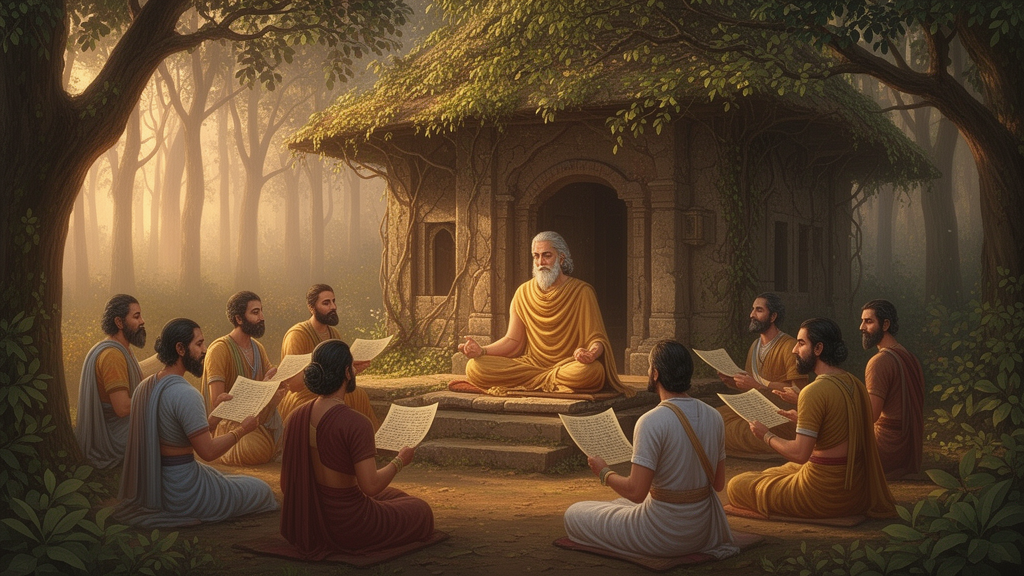
Upanishads in modern practice
Many modern students study the Upanishads for personal reflection, academic training, or cultural literacy. Classes may connect the texts to ethics, leadership, education, or meditation. Such connections are interpretations. A class can present them clearly, but it should not present them as guaranteed results, and it should not claim that studying a text will produce specific worldly, health, or material outcomes. The Bhishma course page, for example, describes applications in daily life as a topic of study. That is a course description. Readers should judge whether the teaching offers reasoned interpretation and textual grounding.
Frequently asked questions
Do I need Sanskrit to join an Upanishad class?
Not always. The Oxford Centre course states that no prior knowledge is needed. Other classes may assume some familiarity with Sanskrit terms or teach them as part of the course. Students should check whether the class teaches Sanskrit, uses translations, or expects prior reading.
Are Upanishad classes the same as reading the Upanishads?
No. A class usually adds structure, explanation, and discussion. Reading a translation gives direct access to the text, while a class adds a teacher’s framework and commentary. Good students often do both and keep track of which points come from the text and which come from the teacher.
Should I choose a course that focuses on one Upanishad or many?
A course on one Upanishad allows detailed study. A survey of many Upanishads gives broader context. Beginners may benefit from a survey first, then a deeper course on one or two texts. Providers’ outlines are the best guide to which approach they take.
Can I rely on recordings instead of live sessions?
Some providers allow it. The Vedanta Amritam page asks students who follow only recordings to inform the teachers, and it describes live participation as central to its course design. Check each provider’s policy before enrolling.
Key takeaways
Upanishad classes can be a practical way to begin studying one of the foundational literatures of Hindu thought. The best choice depends on your goals, language needs, schedule, and interest in tradition, scholarship, or personal reflection. Look for a clear list of texts, a stated teaching tradition, a realistic time commitment, and current information on schedules and fees. Use classes alongside a reliable translation, and keep notes that separate what the text says from what a teacher or commentator adds.
Sources and further reading
- Study of Upanishad, Bhishma School of Indian Knowledge Systems: provider course page describing the Upanishads’ place in Vedic philosophy and a live online course format. Used for the provider’s own course description and claims about its curriculum.
- Study of Upanishads, Bhishma IKS: provider page for a pre-recorded certificate course, listing course content, language of instruction, and registration steps. Used for the list of Upanishads in its syllabus and the course format.
- Vedas and Upanishads Online Course, Oxford Centre for Hindu Studies: course page describing a seven-week introduction to the Vedas and major Upanishads, with notes, lectures, and an essay assessment. Used for the course structure and the list of major Upanishads it studies.
- Upanishad Course, Chinmaya International Foundation: course listing for an online Upanishad course within the foundation’s study programmes. Used to confirm that the course is offered, as shown on the page inspected.
- Join Classes, Vedanta Amritam: class listing that describes an Upanishad class covering ten principal Upanishads commented on by Adi Shankaracharya, and the online, long-term teaching method. Used for the commentary tradition and teaching methodology. Schedules on this page are time-sensitive.
- Upanishad Course Online, Chinmaya International Foundation product page: product listing for the same online Upanishad course. Used as a secondary listing for course availability.