The phrase “two holy books” does not point to one fixed pair of scriptures. Depending on the tradition, it can refer to the two main categories of Hindu scripture, Shruti and Smriti; to the Old and New Testaments of the Christian Bible; to the Quran and the hadith in Islam; or, in popular usage, to the two great epics of Hinduism, the Ramayana and the Mahabharata. This guide explains each meaning, separates what each tradition believes from what the sources describe, and shows how to read a comparison without flattening real differences.

The short answer
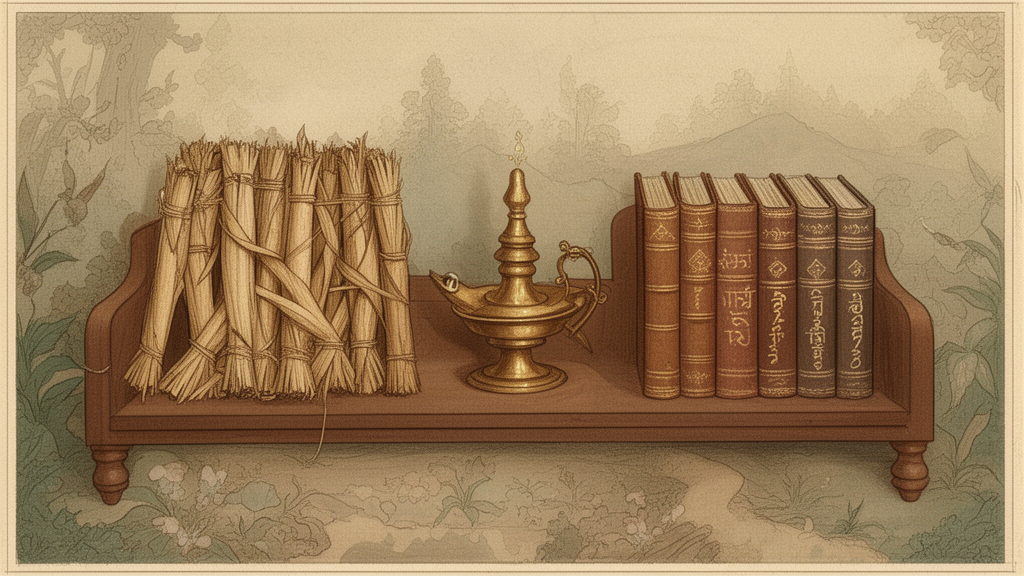
If you are studying Hinduism, the most useful “two” is the classification of Hindu scripture into Shruti (“that which is revealed”) and Smriti (“that which is remembered”). According to Hinduism Facts, Shruti is associated with the Vedic period and includes the four Vedas, while Smriti belongs to the post-Vedic period and includes a large body of texts such as the Ramayana, the Mahabharata, the Bhagavadgita, and the Puranas (Hinduism Facts, Hindu Scriptures and Holy Books).
If you are comparing religions, the most common pairs are different. In Christianity, the Bible is divided into the Old Testament and the New Testament. In Islam, the Quran is the central text, and the hadith, which record the deeds and sayings attributed to Muhammad, are the second major source of religious guidance that Muslims call the sunnah (Wikipedia, List of Islamic texts). The right answer depends on the tradition you mean.
Why “two holy books” has no single answer
The idea of a “holy book” is itself not the same across religions. Beliefnet makes this point directly: “Scripture” means something very different to different religions (Beliefnet, The Holy Books of World Religions). Some traditions center a single text. Others treat a whole body of writings as authoritative, with different texts holding different roles.
Hinduism is a clear example of plural scripture. Hinduism Facts lists the Vedas, their Brahmanas, Aranyakas, and Upanishads, the Vedangas, the Upavedas, the Bhagavadgita, many Puranas, and numerous Smriti works in its overview of Hindu scriptures (Hinduism Facts). A reader who asks for “the” Hindu holy book is usually asking about a category rather than a single volume.
Because of this, a responsible answer to “two holy books” must name the tradition first. The sections below cover the pairs that readers most often mean.
Pair 1: Shruti and Smriti in Hinduism
What Shruti means
Shruti literally means “that which is revealed,” and Hinduism Facts explains that it refers to what ancient sages are understood to have heard during deep meditation. The Shruti literature consists of the four Vedas: the Rigveda, Yajurveda, Samaveda, and Atharvaveda. Each Veda is associated with Upanishads, Samhitas, Brahmanas, and Aranyakas (Hinduism Facts).
The phrase “revealed” is a traditional description. It reflects how many Hindus understand the Vedas as authoritative. It is not a historical claim that can be verified in the way a manuscript date can be verified. Scholars generally study the Vedic texts through linguistic, textual, and historical methods, and that scholarly work is distinct from the devotional belief that the Vedas are eternal or revealed.
What Smriti means
Smriti means “that which is remembered.” According to Hinduism Facts, Smriti belongs to the post-Vedic period and includes the Vedangas, the Ramayana, the Mahabharata, Dharmasutras and Dharmashastras, Arthashastras, Puranas, Upapuranas, the Bhagavadgita, and poetic and commentarial literature (Hinduism Facts).
The same source describes a practical difference: Shrutis are more philosophical and ritualistic, while Smritis are concerned more with moral and civil law. This is a helpful starting point, but it is a summary. Many Smriti texts contain philosophy, devotion, and story alongside law, and many Shruti-related texts discuss ethics. Readers should treat the division as a useful classification rather than a rigid wall.
Why this pair matters for everyday readers
When someone asks about “two holy books” in a Hindu context, Shruti and Smriti are the classification most likely to explain how Hindu scripture is organized. They help a reader see why a Veda, a Purana, and a devotional epic are not treated in the same way within the tradition.
Pair 2: The Ramayana and the Mahabharata
In popular Hindu usage, the Ramayana and the Mahabharata are often discussed together as two great epics. Hinduism Facts lists both among the Smriti texts (Hinduism Facts). Their status as scripture is therefore a matter of how the tradition classifies them, not a claim that they belong to the same category as the Vedas.
Both epics are widely read as stories, teachings, and sources of ethical reflection. Many families know them through retellings, performances, and temple or household recitations. Because these retellings vary by region and language, a reader may encounter the same episode told with different details. This is a normal feature of an oral and written tradition, and it is one reason to be cautious about treating any single retelling as the only version.
Hinduism Facts also includes the Bhagavadgita in its Smriti list, while many readers encounter it as part of the Mahabharata narrative. Some readers therefore treat it as a separate scripture, and others read it as part of a larger epic. Neither approach should be presented as the only correct view.
Practical example
A reader who wants to understand the Ramayana’s teachings on duty may find that different retellings emphasize different characters or episodes. A careful reader can compare a text edition with a commentary from a recognized tradition, then note which parts are narrative, which are teaching, and which are later interpretation. This approach keeps devotion, scripture, and scholarship distinct.
Pair 3: The Old Testament and the New Testament
In Christianity, the phrase “two holy books” is often used as shorthand for the two main parts of the Bible. Beliefnet explains that the Holy Bible is divided into the Old Testament and the New Testament, and that these are further divided into books, chapters, and verses (Beliefnet).
WorldAtlas gives more detail. It states that the Old Testament, also known as the Hebrew Bible and as the Torah to Jews, contains 39 books in the Protestant Bible, 46 in the Catholic Bible, and up to 49 in the Orthodox Bible. It states that the New Testament contains 27 books that are the same across Christian denominations. WorldAtlas also notes that the original language of the Old Testament is primarily Hebrew, with some Aramaic, and that the New Testament was written in Koine Greek (WorldAtlas, Sacred Texts of Major World Religions).
Points of difference
The number of books in the Old Testament differs by tradition, so a reader should not assume that every Christian Bible has the same contents. WorldAtlas also notes that translations and interpretations vary, and that the wording of original texts has been transmitted and studied over time. These are matters for careful study, and reputable translations and commentaries explain the choices made in each edition.
Beliefnet adds that Christianity is the largest religion in the world with over two billion adherents, and that the New Testament centers on the teachings of Jesus Christ, whom Christians believe was the Son of God. These are statements about belief and tradition, and they should be read as descriptions of what Christians hold, not as historical proofs of theological claims.
Pair 4: The Quran and the hadith
The Quran
In Islam, the Quran is the central religious text. Ayat Academy, a Muslim educational website, states that Muslims believe the Quran was verbally revealed by Allah to Muhammad through the angel Gabriel (Jibril) over about 23 years, and that its chapters are called surahs and its verses ayahs (Ayat Academy, What are the Holy books according to Islam?). This is a statement of Muslim belief, and it should be presented as such.
The hadith
The Wikipedia article on Islamic texts states that the hadith are deeds and sayings attributed to Muhammad, and that they comprise the sunnah. It lists six major hadith collections for Sunni Islam, including Sahih Bukhari and Sahih Muslim, and four major hadith collections for Shia Islam, including Kitab Al-Kafi (Wikipedia, List of Islamic texts).
The hadith are not one book with one authority. Different collections are recognized in different communities, and scholars evaluate the transmission of individual reports. The Wikipedia list is a finding aid rather than a legal or theological ruling. Readers who want detailed rulings should consult scholars from their own tradition.
How the pair is often described
Muslims commonly regard the Quran as the primary source and the hadith as a major source for understanding the Prophet’s example. Ayat Academy notes that Muslims view the Quran as the final revelation, and that the belief in earlier Abrahamic scriptures is one of the six articles of faith. It also notes that the idea of tahrif (distortion) limits the extent of this belief for most self-identified Muslims. These differences of view are important for an accurate comparison.
Earlier revelations in Islam: a note on other pairs
Islamic tradition, as summarized by Wikipedia, names the Tawrat (Torah), the Zabur (Psalms), and the Injil (Gospel) as earlier revelations, along with the Scrolls of Abraham and the Scrolls of Moses (Wikipedia, List of Islamic texts). Ayat Academy states that the Quran mentions the Tawrat, the Psalms, and the Gospel by name (Ayat Academy).
Readers sometimes search for “two holy books” and mean the Torah and the Quran, or the Bible and the Quran. These comparisons are legitimate, but they require care. Muslims and Jews, and Muslims and Christians, understand the relationships among these texts in different ways. Treat any comparison as a description of each tradition’s own claims.
How to read a two-book comparison responsibly
A good comparison begins by naming the texts, their traditions, and their roles. Without that, it is easy to compare unlike categories. For example, comparing the Vedas with the Bible treats a set of Vedic texts with a canon of books that is organized differently. Comparing the Ramayana with the Gospel of John compares a narrative epic with a specific New Testament book.
Use these four labels
- Text: what the scripture itself contains, with the edition or translation named.
- Tradition: how a community understands and uses the text.
- Belief: what adherents hold to be true, including claims about divine origin.
- Scholarship: historical, linguistic, and critical study of when and how the text was composed and transmitted.
These labels prevent a common error: presenting a devotional belief as an academic finding, or presenting an academic date as a religious claim.
Regional and community differences
Hindu practice varies widely. Scripture may be read in Sanskrit, in regional languages, through commentary, or through oral performance and devotional song. A family may give special attention to one text, while a temple community may emphasize another. Because of this variety, no single list of “holy books” should be treated as universal for all Hindus.
The same is true for Christianity and Islam. Christians differ in the books they include in the Old Testament, and Muslims differ in which hadith collections carry the most weight. Explaining these differences is not a weakness in the topic. It is necessary for an accurate answer.
Practical steps for studying two holy books
- Name the tradition. Decide whether you are studying Hinduism, Christianity, Islam, or a comparison.
- Choose an edition or translation. Note the translator, publisher, and whether the text is an annotated edition.
- Separate the layers. Mark which passages are scripture, which are commentary, and which are modern explanation.
- Read the classification. For Hinduism, learn the Shruti and Smriti distinction before comparing individual texts.
- Check claims against sources. Use scholarly editions or institutional resources for historical dates and textual history.
Related HindusGod.com guides
Readers who want a broader view of holy-book lists can explore related drafts on this site. Each link below points to a WordPress draft that may not yet be publicly visible; confirm publication status before sharing.
- Two Holy Books Name, for readers who arrive with a naming question.
- Three Holy Books, for comparisons that group three texts.
- 3 Holy Books, for a numbered-list approach to scripture.
- 5 Holy Books, for a broader selection of texts.
- 7 Holy Books, for a longer survey.
- 10 Holy Books, for an overview of major scriptures.
- Different Holy Books, for differences in form and purpose.
- Famous Holy Books, for widely known texts.
- Four Holy Books, for a comparison of four traditions or texts.
- Holy Books Name, for a glossary-style introduction.
- Types of Holy Books, for classification by genre and role.
- Holy Books and Prophets, for readers interested in the link between revelation and prophetic figures.
Frequently asked questions
Is the Bhagavad Gita one of the two holy books of Hinduism?
The Bhagavadgita is listed among the Smriti texts in Hinduism Facts’ overview (Hinduism Facts). It is widely read and revered, but it is not usually described as one of two fixed holy books of Hinduism. Its importance depends on the reader’s tradition, lineage, and devotional practice.
Are the Ramayana and the Mahabharata Shruti?
Hinduism Facts places both the Ramayana and the Mahabharata in the Smriti category, which it describes as post-Vedic and concerned with moral and civil law as well as narrative and philosophy (Hinduism Facts). Some communities give them devotional authority in ways that go beyond their classification, so presenting them as simply “stories” would be inaccurate.
Do Muslims consider the Torah and the Gospel holy books?
Muslim tradition names the Tawrat, the Zabur, and the Injil as earlier revelations (Wikipedia, List of Islamic texts). Ayat Academy notes that Muslims believe the Quran completes and confirms earlier writings, while also explaining that the idea of tahrif limits the extent of this belief for most self-identified Muslims (Ayat Academy). The relationship is therefore a matter of Islamic belief and interpretation.
Summary
The phrase “two holy books” can refer to Shruti and Smriti in Hinduism, to the Old and New Testaments in Christianity, to the Quran and hadith in Islam, or to the Ramayana and Mahabharata in popular Hindu usage. The most accurate answer begins by identifying the tradition and the kind of classification being discussed. Readers who keep text, tradition, belief, and scholarship separate will find the subject clearer and more respectful of the communities that hold these scriptures.
Sources and further reading
The sources below were inspected during this research run. They are mostly secondary or educational summaries, so readers who need precise textual, historical, or legal detail should consult scholarly editions and commentaries from recognized institutions. Primary scripture editions were not retrieved for this draft and are therefore not linked.
- Hinduism Facts, Hindu Scriptures and Holy Books: Shruti and Smriti definitions, the four Vedas, and the lists of Smriti texts, including the Ramayana, Mahabharata, Bhagavadgita, and Puranas.
- Wikipedia, List of Islamic texts: the Quran, earlier revelations named in Islamic tradition, and the major Sunni and Shia hadith collections.
- Wikipedia, List of religious texts: an overview of religious texts across traditions, including Hinduism among Indian religions. Used for orientation only.
- Ayat Academy, What are the Holy books according to Islam?: a Muslim educational summary of the Quran, Tawrat, Zabur, Injil, and the belief in earlier scriptures, including the concept of tahrif.
- Beliefnet, The Holy Books of World Religions: an introduction to how scripture differs across religions and a description of the Bible’s structure.
- WorldAtlas, Sacred Texts of Major World Religions: book counts for the Old and New Testaments, languages of composition, and notes on translation and textual transmission.