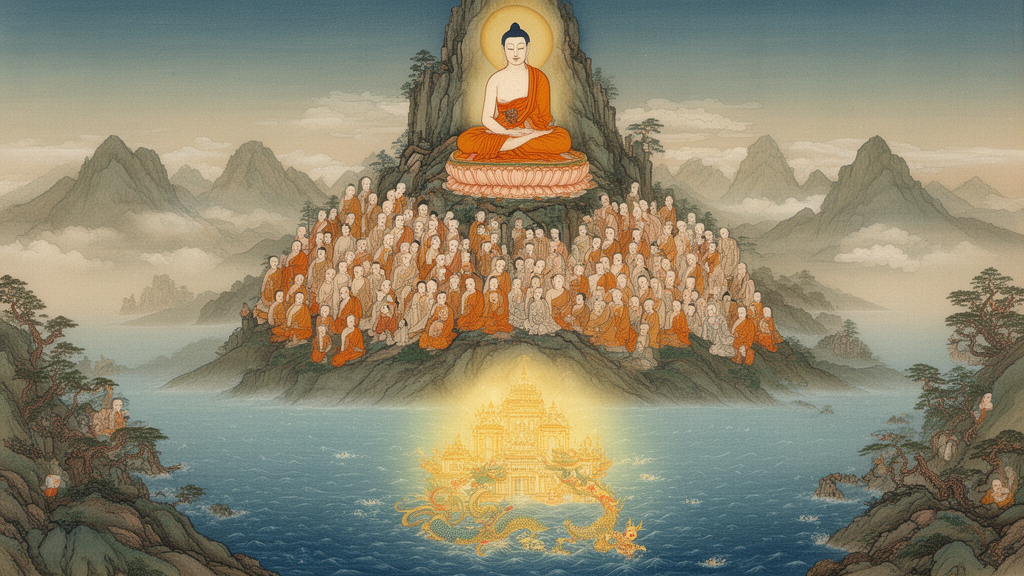
The phrase “the dragon sutra” most often points to the Sutra Spoken by the Buddha on the Sea Dragon King (佛說海龍王經, fó shuō hǎi lóng wáng jīng), also called the Dragon King Sutra. It is a Mahayana Buddhist scripture in which Sakyamuni Buddha teaches the Sea Dragon King and his retinue on Vulture Peak, and then accepts an invitation to teach in the Dragon Palace beneath the ocean. The English-language publisher of one widely available edition, dragonkingsutra.org, describes it as a Mahayana sutra translated in the Western Jin dynasty by the Tripitaka Master Dharmaraksa of the Yuezhi. This article explains what the text is, how it is structured, what its teachings are said to cover, and where the claims about its benefits come from.
Because this is a Buddhist scripture, it is not a Hindu text. Readers searching for Hindu naga traditions or Hindu sources on dragon-like beings will need different references. The sources used here are Buddhist editions and Buddhist educational materials, so the discussion below stays within that frame.
What the Dragon Sutra is
The text is known by several names in English. You will see Sutra Spoken by the Buddha on the Sea Dragon King, Dragon King Sutra, Dragon-King Sutra, and Teachings of the Dragon King Sutra. The common search term “the dragon sutra” usually refers to this same work, but it can be ambiguous. A reader who wants a different dragon-related text, such as a Hindu, Chinese folk, or Japanese text, should check the title, translator, and tradition before relying on a source.
The Chinese title identifies the Buddha as the speaker and the Sea Dragon King as the principal listener. Edition titles in English vary, but the core scene remains the same: a dialogue between the Buddha and the dragon king and his assembly, followed by a visit to the dragon realm.
The text belongs to the Mahayana Buddhist canon, which is the body of scriptures used in East Asian Buddhism and in other Mahayana communities. Its teachings emphasize bodhisattva practice, dharani, compassion, and the realization of emptiness. Those themes are the reason many readers study it alongside other Mahayana sutras.
Setting: Vulture Peak and the Dragon Palace
The narrative opens in a familiar Mahayana setting. According to the Chinese and English text presented on dragonkingsutra.org, the Buddha is on Vulture Peak (Gridhrakuta, Ling Shan) at Rajagrha, together with a large assembly of monks. The opening lines follow the standard “Thus have I heard” formula used in many sutras, and the English translation on that site renders the first scene as the Buddha dwelling on Vulture Peak with a great assembly of bhiksus.
The second movement shifts from the mountain to the sea. The site describes the Buddha accepting the dragon king’s invitation to teach in the Dragon Palace. The scene is central to the sutra’s identity: the Buddha’s teaching reaches beings who live far from the human world, and the text presents those beings as capable of listening, practicing, and receiving predictions.
For readers, the setting is useful for understanding the text’s purpose. The sutra is less a systematic treatise and more a narrative that brings teaching to beings usually considered outside ordinary human reach.
Translation and structure
The English-language reader’s edition on dragonkingsutra.org presents the text in four volumes with twenty chapters. The site lists the chapter titles in Chinese, Pinyin, and English, with Spanish and French versions in its interface. The structure, as listed on that site, is as follows:
- Volume I: chapters on Practice, Discernment, The Six Perfections, and The Inexhaustible Treasury.
- Volume II: chapters on Dharani, The Body of Dharani, The Gate of Dharani, Discerning the Name, and Bestowing the Prediction.
- Volume III: chapters on Inviting the Buddha, The Ten Virtues and the Six Perfections, the predictions for the Asura Yanju, the Dragon King Anavatapta, and the girl Jewel Brocade, and Sakra, Lord of the Devas.
- Volume IV: chapters on the Garudas, The Relics, The Offering of Dharma, Emptiness and Purity, and Entrusting and Upholding.
The chapter list shows that the text covers more than dragons. It includes predictions for named beings, teachings on the perfections, reflections on dharani, and passages about devas and garudas. Readers who expect a short story about a dragon will find a longer and more varied scripture.
The translation credit is the most important bibliographic detail. The site identifies the translator as Dharmaraksa and the period as the Western Jin dynasty. The Buddhist Education Centre in Australia gives the same general setting for the sutra as a text in the Chinese Tripitaka. A full critical edition, a comparison of Chinese versions, and an academic dating study were not gathered for this article, so any statement about exact dates or textual variants should be checked against a scholarly source before publication.
Key themes in the sutra’s presentation
Dragons as beings who can awaken
The dragonkingsutra.org study pages present a central theme: dragon kings are not only protectors of the dharma but also sentient beings who can attain buddhahood. The site describes them as cultivators from former lives who were reborn as dragons and who still move through the Six Realms like other beings. This is the site’s reading of the sutra’s message, and it is worth distinguishing from the scripture itself. The sutra’s narrative includes predictions and teachings for dragon-related beings, which supports the idea that they are included in the path, but the site’s wording is a modern devotional explanation.
The three burning sufferings
The same site lists three sufferings it associates with dragon existence: scorching sand that burns to the marrow, humiliation of form, and a constant fear of the Garuda. The site adds that even splendor does not escape suffering. These points are presented as a summary of teachings in the sutra’s study materials. Readers who want to verify the exact wording should compare the Chinese text and a published translation rather than rely on the summary.
Harmonizing the Eight Classes
The site also refers to the Eight Classes of heavenly and dragon beings, which in Buddhist usage include devas, nagas, asuras, garudas, and others. It states that the sutra helps harmonize these classes. This is a devotional claim taken from the publisher’s materials and quotes attributed to Living Buddha Lian Sheng. It is not a finding from an independent academic study, and it should be presented as the tradition’s perspective.
Stanzas in English: the Chen summary
Many English readers first meet the sutra through a verse summary rather than the full text. The Buddhist Education Centre in Australia publishes Dragon King Sutra Stanzas, which states that the sutra had not been printed separately by any publisher and was of considerable length. It explains that Buddhist yogi C.M. Chen (Chien-Ming Chen) summarized its essence in English stanzas and printed them. The same page says Chen practiced meditation in Kalimpong, India, for 28 years, and that his hope was for the stanzas to spread widely.
The stanzas open with the Buddha on Condor Mount and a great canopy that appears in the sky. Maudgalyayana asks about the sign, and the Buddha explains that the Dragon King will soon come to him. The dragon king then praises the Buddha and asks about the bodhisattva’s conduct, how to remove evil, and the Buddha’s wisdom and prophecy.
The Buddha’s reply in the stanzas presents four instructions:
- Refrain from harming others.
- Keep the ten good practices.
- Do not speak of others’ faults.
- Do not praise oneself with false pride.
The stanzas then describe the powers that may come from practice, such as the heaven-eye, the heavenly ear, knowledge of others’ minds, recollection of past lives, and the wisdom that ends defilements. Those are traditional Buddhist descriptions of advanced practice. In a modern reading, they are best understood as part of a path of training rather than as promised rewards for reading the text. The stanzas are also a summary by a modern author, so they should not be cited as the sutra’s exact wording.
The Scribd upload titled Teachings of the Dragon King Sutra contains a similar verse version and an AI-generated summary. It was not used as a primary source for any claim in this article because its provenance and reliability could not be confirmed.
Recitation and devotional practice
Many Buddhist communities value recitation, copying, and sharing of sutras. The dragonkingsutra.org site presents the sutra as a text whose recitation brings blessings and whose circulation supports merit. It also reports that people who have printed and shared the text have experienced positive results. Those claims are devotional and anecdotal, and the site presents them as the teaching of its own community.
The article therefore treats such claims as belief statements. It does not confirm them, and it does not promise any material outcome. Health, wealth, protection, and success are not supported by independent evidence in the sources used here. A reader can study the text for its teachings on conduct, compassion, and wisdom, and can decide for themselves how to practice within their own tradition.
Practice also varies between communities. Some readers recite the full text, some use the verse summary, some study the Chinese or English edition, and some use the sutra mainly as a teaching text. No single method is presented here as the standard.
How to read the sutra responsibly
A useful approach has three steps. First, read the text in a reputable edition, preferably one that names the translator and gives the source. Second, compare the English reader with the Chinese text if you read Chinese. Third, keep devotional summaries separate from the scripture itself.
For example, if a website says the sutra ends fear or guarantees wealth, that is a claim about the website’s teaching rather than a statement you can verify in the scripture. If a website says the sutra describes three burning sufferings, you can check the chapter that the site cites, or compare a translation. The distinction matters because it helps readers avoid treating commentary, stanzas, and modern devotional language as identical to the sutra.
Why the dragon sutra is useful for Buddhist study
The sutra is useful for readers interested in the range of beings in Mahayana cosmology, the role of predictions in the bodhisattva path, and the place of dharani and offerings in devotional practice. It also shows how Buddhist narratives include beings outside the human world, which is one reason it is discussed alongside sutras that describe heavenly beings and bodhisattvas.
Readers who want to explore related Mahayana themes can begin with the HindusGod.com draft target pages below. These pages are in draft status at the time of this writing, so the links may not be public until the owner publishes the target posts. Each link is included because its topic supports a related part of this discussion, not because it proves a claim in this article.
- For bodhisattva and Mahayana cosmology, see Avatamsaka Sutra, which is a broad Mahayana text on the Buddha’s realm and bodhisattva practice.
- For the stages of the bodhisattva path, see Dasabhumika Sutra.
- For the role of dharani in Mahayana practice, see Dharani Sutra.
- For meditation and mental training, see Dhyana Sutra.
- For compassion and the Bodhisattva of Compassion, see Avalokiteshvara Sutra.
- For the wider Mahayana discussion of emptiness and wisdom, see Diamond Sutra Meaning.
- For precepts and bodhisattva conduct, see Brahmajala Sutra.
- For a bodhisattva associated with space and wisdom, see Akasagarbha Sutra.
- For Agama texts and early Buddhist teachings, see Agama Sutra.
- For Pure Land teachings and the Buddha Amitabha, see Amida Sutra.
The HindusGod.com links above are internal draft targets and should be checked again before any publication.
Frequently asked questions
Is the dragon sutra a Hindu text?
No. The Dragon King Sutra is a Mahayana Buddhist scripture. Its narrative centers on Sakyamuni Buddha, Vulture Peak, and the Dragon Palace. Readers looking for Hindu dragon or naga texts should consult sources from Hindu traditions.
Who translated the Dragon King Sutra?
The English reader’s edition on dragonkingsutra.org credits the Chinese translation to the Tripitaka Master Dharmaraksa of the Yuezhi, during the Western Jin dynasty. Other editions may give different details, so check the edition you are using.
Is there an English version I can read?
Yes. dragonkingsutra.org publishes a reader in English, Chinese, Spanish, and French. The Buddhist Education Centre also publishes an English verse summary titled Dragon King Sutra Stanzas. A verse summary is not the same as a full translation.
Summary and next step
The Dragon King Sutra, often called “the dragon sutra,” is a Mahayana Buddhist scripture about the Buddha’s teaching to the Sea Dragon King and his assembly on Vulture Peak and in the Dragon Palace. Its English availability includes a four-volume reader and verse stanzas. Its teachings on dragons, bodhisattva practice, dharani, and the Eight Classes are best understood from the text, its translator, and reputable commentary.
The next step is to read the sutra in a published edition, note the translator and chapter, and compare any devotional summary with the scripture. Claims about benefits should be treated as belief statements from the tradition rather than verified results.
Sources and further reading
- Dragon King Sutra 佛說海龍王經 homepage: used for the sutra’s description, Vulture Peak and Dragon Palace setting, translator credit, and the site’s devotional claims about recitation.
- Read the Sutra, Dragon King Sutra 佛說海龍王經: used for the four-volume structure, chapter list, and translator credit.
- Dragon King Sutra Stanzas, Buddhist Education Centre: used for the history of the English stanzas, the role of Yogi C.M. Chen, and the four instructions in the verse summary.
Further academic reading on the Chinese translation history, textual variants, and comparison with other dragon-king texts was not verified for this draft and should be added by the editor before publication.