The Tejobindu Upanishad is a minor Sanskrit Upanishad that focuses on meditation. Its central instruction is to meditate on the tejobindu, a “radiant point” that the text presents as the inner Self of the universe. The text treats practice as more important than bookish learning and presents Vedanta teaching through the lens of yoga. It is one of the five Bindu Upanishads and is usually counted among the Yoga Upanishads. This guide explains the text’s name, its place in Upanishadic literature, its main teachings, and the variations in how it is transmitted, so readers can tell what the text says apart from later commentary and modern interpretation.
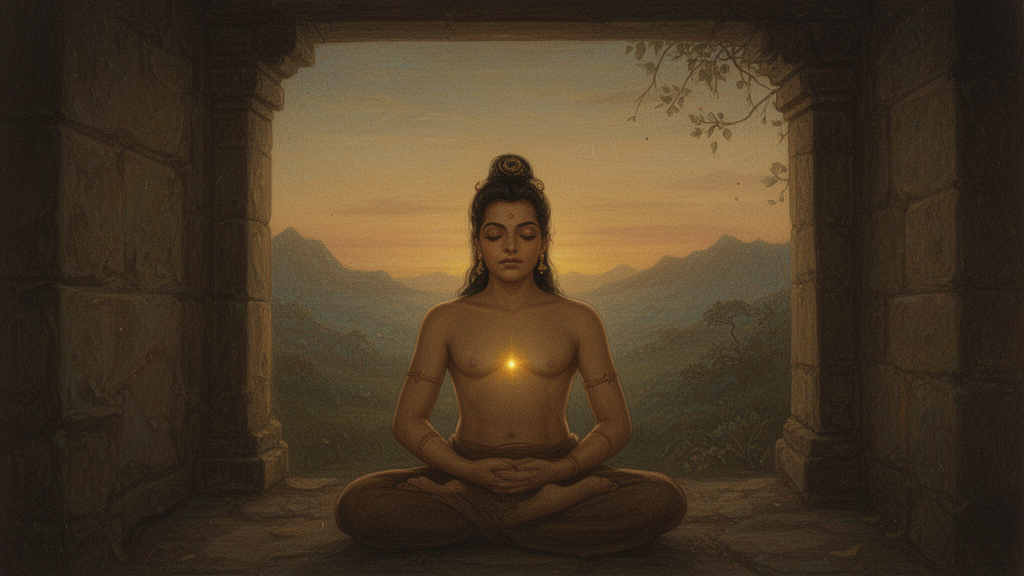
What the Tejobindu Upanishad Is
The Tejobindu Upanishad (Sanskrit: तेजोबिन्दु उपनिषद्) is a minor Upanishad in the corpus of Upanishadic texts of Hinduism. Wikipedia’s article on the text describes it as one of the five Bindu Upanishads, all of which are attached to the Atharvaveda in the most common account, and as one of twenty Yoga Upanishads among the Upanishads of the four Vedas.[1] The same article notes that it is especially known for its emphasis on meditation. It describes dedication to bookish learning as empty without practice, and it presents Vedanta doctrine in terms of yogic discipline.
For a general introduction to what the word Upanishad means and how the collection is organized, readers can start with our draft guide, Meaning of Upanishad, which is a target draft and may not yet be public. For the wider list of texts, see our draft on 108 Upanishad (target draft; may not yet be public).
Name and Meaning of Tejobindu
The title combines two Sanskrit words. Tejas is usually translated as radiance, fiery energy, or spiritual luster. Bindu means a point, drop, or small seed. Taken together, the title is commonly rendered as the “radiant point” or “radiant power of the point.”
The German Indologist Paul Deussen, as cited in Wikipedia and in the Vyasa Mahabharata summary of the text, explains the name as “the point representing the power of Brahman,” where the point is identified with the anusvara, the nasal dot associated with the sacred syllable Om.[1][4] This is an interpretive reading from a scholar, not a statement that appears in the text as a definition. It is useful, however, because it links the title to the Om-based meditation practices common in Upanishadic literature.
Tejobindu and Tejabindu Spellings
Readers may see the title spelled as Tejabindu Upanishad, with the Sanskrit rendered as तेजबिन्दु. Wikipedia and the Vyasa summary both note this variant, which appears in the Poona manuscript versions.[1][4] Both spellings refer to the same text. When searching catalogs or manuscript collections, it is helpful to check both forms.
Where the Text Fits in the Upanishadic Literature
The Tejobindu Upanishad belongs to several overlapping groupings. Each grouping describes the text differently, so it helps to separate them.
- Bindu Upanishads: The text is one of five Bindu Upanishads. The Vyasa summary lists the other four as the Nadabindu, Brahmabindu, Amritabindu, and Dhyanabindu Upanishads, and notes that the Tejobindu is the longest of the five.[4]
- Yoga Upanishads: Wikipedia counts it among twenty Yoga Upanishads associated with the four Vedas.[1]
- Muktika canon: The text appears as number 37 in the serial order of the Muktika, the list in which Rama reveals 108 Upanishads to Hanuman, according to the modern-era anthology of 108 Upanishads.[1] The Sanskrit Documents text record also lists the work as 37/108 and classifies it as a Krishna Yajurveda Yoga Upanishad.[3]
Different Vedic Attachments
Traditions do not agree on the Veda to which the text belongs. Wikipedia reports that Deussen linked the Tejobindu and the other Bindu Upanishads to the Atharvaveda, while Ayyangar linked it to the Krishna Yajurveda. The article also notes that the text has been attached to different Vedas depending on the region where a manuscript was found.[1][4] The Sanskrit Documents classification uses the Krishna Yajurveda label.[3] Readers should treat this as a matter of manuscript and editorial tradition rather than a settled fact.
Different Numbering in Collections
Lists of Upanishads also differ. The Vyasa summary reports that Colebrooke’s version of 52 Upanishads, popular in north India, gives the Tejobindu as number 21, while the Narayana anthology places it at number 21 in the Bibliotheca Indica. The Oupanekhat, a Persian translation of fifty Upanishads prepared under Dara Shikoh in 1656, lists it as number 27 under the name Tidj bandeh.[4] These numbers describe how collections were organized, not the rank of the text’s teachings.
Date and Composition
Dating ancient Sanskrit texts is difficult, and sources differ in their approach. Wikipedia and the Vyasa summary both cite the scholar Gavin Flood, who places the Tejobindu, along with other Yoga Upanishads, in roughly the 100 BCE to 300 CE period.[1][4] Mircea Eliade suggested that the text may have been composed in the same period as the didactic parts of the Mahabharata and other early Sannyasa and Yoga Upanishads, and that it was probably composed earlier than the later Yoga Upanishads such as the Yoga-kundalini, Varaha, and Pashupatabrahma.[1]
These are scholarly estimates. They are not certainties, and the range is broad. Readers should not treat a single date as settled, and the text’s devotional and philosophical value does not depend on a precise date.
The Main Teaching: Meditation Over Mere Study
The most distinctive feature of the Tejobindu Upanishad is its emphasis on practice. Wikipedia summarizes the text as calling dedication to bookish learning rubbish and emphasizing practice instead.[1] In plain terms, the text argues that reading and memorizing scripture is not enough. Realization comes through disciplined meditation.
This emphasis does not mean the text rejects scripture. It places scriptural understanding inside a practical path, where the goal is direct experience of the Self. Readers who study Upanishads often find this a helpful corrective: the Upanishadic tradition is full of teachers who ask students to test ideas in experience, not only in words.
Meditating on the Tejo-bindu
The opening chapter of the text instructs that the supreme meditation (param dhyana) should be directed to the tejo-bindu. In the English translation by K. Narayanasvami Aiyar, published in 1914 and available on Wisdomlib, the point is described as the Atman of the universe, seated in the heart, very subtle, associated with Shiva, and both gross and subtle while also beyond these qualities.[6] The translation also describes this meditation as difficult to perform and difficult to attain, and it describes a set of moral and disciplined qualities needed by those who undertake it, including moderate eating, control of anger and passions, and freedom from egoism.[6]
Because this is a 1914 translation, its wording reflects its time. Readers who want to compare translations should consult more than one edition. The emphasis on inner qualities, however, is a recurring thread across many Upanishads and yogic texts.
Qualities That Support Meditation
The Aiyar translation lists several conditions for the practitioner, such as moderate diet, controlled anger, detachment from social attachments, mastery over passions, and endurance of opposites such as heat and cold.[6] These are presented as preparation for the inner discipline the text describes. They are not a guarantee of any worldly result, and the text’s teaching is framed around liberation from bondage rather than material benefit.
The Fifteen-Limbed Yoga
Wikipedia includes a section on what it calls the fifteen-limb yoga within the text.[1] A secondary summary available online describes the system as integrating limbs such as yama, niyama, asana, pranayama, pratyahara, dharana, dhyana, and samadhi, performed with constant contemplation on Brahman.[2] That summary has not been checked against the Sanskrit text or a scholarly translation in this draft, so readers should verify the exact list of limbs in a primary edition before relying on it.
The eight-limbed scheme in the Yoga tradition familiar from the Yoga Sutras is a useful point of comparison, but the Tejobindu’s fifteen-limbed system should be read in its own terms. Comparison helps readers see family resemblance, not identity.
Atman, Brahman, and Non-Duality
The text presents the Vedanta view that the individual Self (Atman) and the ultimate reality (Brahman) are not truly separate. Wikipedia’s chapter headings for the text include sections on Atman and Brahman, on jivanmukti and videhamukti, and on the nature of Satcitananda.[1]
In the Aiyar translation’s opening chapter, the meditated point is described as Brahman and as the highest seat of Vishnu, and also as beyond thought, speech, and ordinary description.[6] These descriptions are paradoxical by design. The text uses negations to point beyond conceptual understanding, which is a common method in Upanishadic and Vedanta writing.
Satcitananda
Satcitananda, often rendered as being, consciousness, and bliss, is a term used in Vedanta for the nature of Brahman. Wikipedia lists a section on the nature of Satcitananda within the Tejobindu’s contents, and a secondary summary describes the text as teaching non-dual realization of consciousness as homogeneous and all-pervading.[1][2] For a precise understanding, readers should compare how their chosen translation renders the relevant verses.
Liberation: Jivanmukti and Videhamukti
Two terms often appear in discussions of liberation. Jivanmukti refers to liberation while living in the body, and videhamukti refers to liberation after bodily death. Wikipedia lists a section on these two concepts in its outline of the Tejobindu.[1] Readers should note that these terms are developed in later Vedanta commentary as well, so the exact meaning should be checked against the wording of the specific Upanishad passage being studied.
Atman Versus Anatman
Wikipedia includes a section titled Atman versus Anatman in its outline of the text.[1] In Indian philosophy, anatman, or non-self, is most associated with Buddhist teaching, while Vedanta affirms the Atman. A reader studying this section should keep the Upanishadic affirmation of Atman distinct from Buddhist critiques of a permanent self. The comparison is part of scholarly discussion, not a claim the Upanishad makes about Buddhism.
Reception, Commentary, and Modern Editions
The Tejobindu Upanishad has been known in several forms. Wikipedia notes that manuscripts vary, including the Poona versions with the variant spelling Tejabindu.[1] The Internet Archive holds a record for a Tejobindu Upanishad with a Bhasha tika, a vernacular commentary, by Sadhu Bhagawan Singh, published by Dharma Press, Delhi.[5] A commentary of this kind reflects the interpretation of its author and tradition, so readers should distinguish it from the root text.
Sanskrit Documents provides a transliterated text in Sanskrit and records its source details, including the transliteration and proofreading credits for that version.[3] Readers who work with Sanskrit should compare any digital text against a printed critical or traditional edition, because digital transcriptions can contain errors.
How to Read the Tejobindu Upanishad Responsibly
Readers new to the text can approach it in a few practical steps:
- Choose a translation and note it. The 1914 Aiyar translation on Wisdomlib is one accessible English option. Vyasa Online also provides a page for the Tejobindu, with links and a summary.[4]
- Separate the text from the commentary. When a commentary explains a term, mark it as the commentator’s view.
- Read the practice sections alongside the philosophy. The text’s teaching is meant to inform practice, so read it slowly and compare the practical instructions with the metaphysical claims.
- Check tradition-specific practice. Meditation instructions in Upanishads are not all practiced in the same way across Hindu communities. A teacher or lineage may explain how a passage is used in their own tradition.
Frequently Asked Questions
Is the Tejobindu Upanishad about a deity?
The text centers on the tejo-bindu, the radiant point, and presents it as the Self of the universe and as Brahman. Some passages describe it in terms associated with Shiva and Vishnu, so readers should read the passage carefully and follow the translator’s wording rather than assume a single deity identity.[6]
Why is the title spelled in different ways?
The Sanskrit form तेजोबिन्दु is standard in many modern sources. The variant Tejabindu appears in the Poona manuscript versions, as noted by Wikipedia and the Vyasa summary.[1]
Does reading this text guarantee a spiritual result?
No text can guarantee a particular outcome. The Upanishad presents meditation and inner discipline as the path to realization. Whether and how a practitioner progresses is a matter of personal practice and teacher guidance, not a promise the text makes in a measurable way.
Key Takeaways
The Tejobindu Upanishad is a short, practice-focused Upanishad in the Yoga and Bindu groups. Its central idea is meditation on the tejo-bindu as the inner Self and ultimate reality. Its manuscript history includes different Vedic attachments, numbering systems, and spellings, and scholars date it broadly to the early centuries BCE and CE. A careful reader will keep the text, the translation, the commentary, and modern scholarship distinct, and will treat its instructions as tradition-specific guidance rather than universal practice.
Sources and Further Reading
- Tejobindu Upanishad, Wikipedia: overview of the text, its Bindu and Yoga groupings, Muktika numbering, dating by Flood and Eliade, and Deussen’s explanation of the title.
- Tejobindu Upanishad, Vyasa Mahabharata: summary of numbering in Colebrooke, Narayana, and Dara Shikoh collections, and the Poona spelling variant.
- Tejobindu Upanishad of Krishna-yajurveda, Chapter I, Wisdomlib: K. Narayanasvami Aiyar’s 1914 English translation of the opening chapter, used here for paraphrase of the meditation instruction.
- Tejobindu Upanishad, Sanskrit Documents: transliterated Sanskrit text record with category and numbering details.
- Tejobindu Upanishad with Bhasha Tika, Internet Archive: catalog record for a vernacular commentary edition.
Internal reading on HindusGod.com (target drafts; may not yet be public): Meaning of Upanishad, 108 Upanishad, Atharva Upanishad, Atharvashikha Upanishad, Advaita Upanishad, Atmabodha Upanishad, Adhyatma Upanishad, Avadhuta Upanishad, Aitareya Upanishad, Ashtavakra Upanishad.