The phrase Shankara Upanishads usually refers to the Upanishadic texts as read through the commentaries (bhashya) of Adi Shankara, the 8th-century philosopher who systematized the nondual school of Advaita Vedanta. Shankara did not write a separate set of Upanishads. Instead, he is traditionally credited with commentaries on the principal Upanishads, and those commentaries shaped how many Hindus, scholars, and teachers understand the Upanishads today. This guide explains who Shankara was, what his commentaries are, the core teachings readers most often encounter, and where the tradition, the historical evidence, and modern interpretation differ.
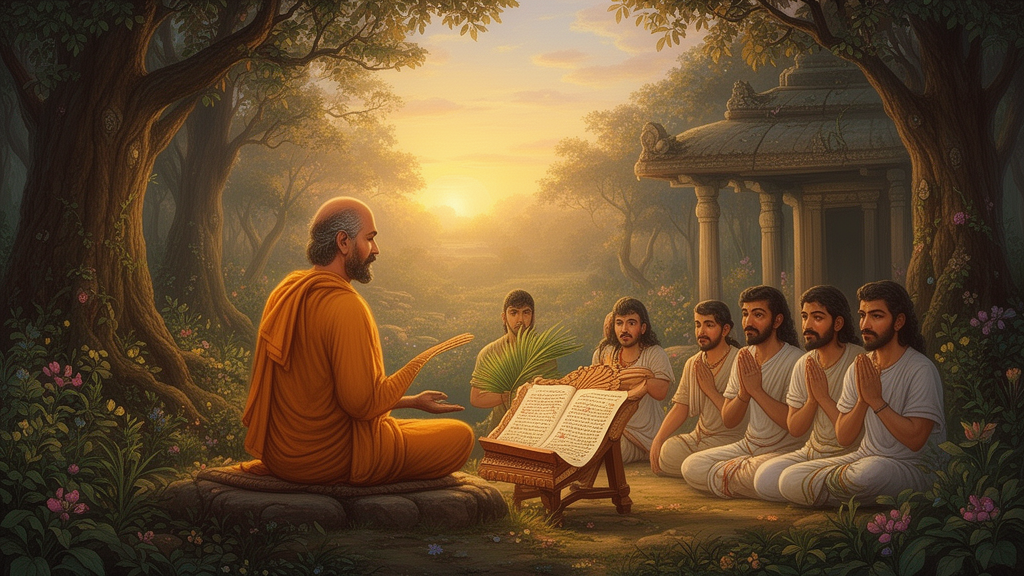
What the Phrase “Shankara Upanishads” Usually Means
The Upanishads are a body of philosophical texts that form the concluding portions of the Vedas. Many are called Vedanta, meaning roughly “the end of the Vedas” or “the culmination of the Veda,” a name that refers both to their position in the Vedic corpus and to their central concern with ultimate reality. Readers searching for this phrase are generally looking for one of three things:
- an explanation of the Upanishads that Shankara commented upon;
- an introduction to Shankara’s Advaita (nondual) reading of those texts; or
- a way to tell apart the Upanishads themselves, Shankara’s commentaries, and later works attributed to him.
These three things are related but distinct. The Upanishads are scripture within the Hindu tradition. Shankara’s commentaries are an interpretive tradition built on that scripture. Later manuals, devotional hymns, and hagiographies are a further layer. Keeping these layers separate is the most useful way to read the subject.
Who Adi Shankara Was
Britannica describes Shankara as a prominent Indian philosopher who founded the nondualist Advaita Vedanta school and who flourished in the 8th century. It also notes that he initiated four institutes across India, which continue to influence religion in the country. (Source: Britannica, linked in the Sources section.)
Dates for Shankara are a point of disagreement. Wikipedia’s article on Adi Shankara has a section on dating that separates the datings given in monastic (matha) traditions from those proposed by modern scholars and from other historical estimates. Readers should treat any single exact year as a claim that depends on the source. The safest statement, supported by Britannica, is that he is generally placed in the 8th century.
Wikipedia’s article also distinguishes several kinds of material about his life:
- Traditional views, which present Shankara as a divinely inspired teacher who restored the Vedic dharma;
- Historical views, which question how much of the later biographical material can be verified;
- Hagiographies, such as the Digvijaya (“conquests of Shankara”) literature, which developed in later centuries and contain legendary episodes such as debates, travels, and deaths at various places.
Each of these may be meaningful to a devotee or a student, but they belong to different categories. A hagiography can express devotion and communal memory without being a historical record.
Shankara’s Commentaries on the Upanishads
Shankara’s main literary contribution, as traditionally understood, is a set of commentaries on the Upanishads, the Bhagavad Gita, and the Brahma Sutras (sometimes called the Vedanta Sutras). Together these three sources are called the Prasthanatraya, the “three foundations” of Vedanta. The commentaries on the Upanishads are the part most relevant to this topic.
Wikipedia’s article on Shankara’s works is organized into two groups: works of accepted authenticity and works of doubtful or non-authentic attribution. This distinction matters. Many texts have been attributed to Shankara over the centuries, including poems, hymns, and treatises. Scholars have examined manuscript evidence, style, and content to decide which works are likely his. Readers who see a title in a bookstore or online should check whether it appears in a scholarly edition and whether its attribution is discussed.
Commentaries on the Upanishads commonly follow a pattern. Shankara typically introduces the text, explains its context, comments on individual passages, and then argues against rival readings. This style is closer to philosophical argument than to devotional storytelling. Students often find it helpful to read the Upanishad itself first, then the commentary, then a modern study that explains the commentary’s arguments.
Principal Upanishads Traditionally Associated with Shankara
Tradition commonly associates Shankara with commentaries on a group of ten principal (mukhya) Upanishads. These usually include the Isha, Kena, Katha, Prashna, Mundaka, Mandukya, Taittiriya, Aitareya, Chandogya, and Brihadaranyaka. The exact list, and the authorship of individual commentaries, should be confirmed against a scholarly edition before it is cited in print, since attribution details vary among editions and academic discussions. The Mandukya Upanishad is often studied with the Mandukya Karika attributed to Gaudapada, Shankara’s influential predecessor in the Advaita line.
These texts are not all alike. The Brihadaranyaka and Chandogya are long prose Upanishads with extensive dialogues. The Isha and Mundaka are shorter and more compact. Because their styles differ, a reader who begins with a short Upanishad with a commentary often understands the method of Advaita more quickly than a reader who starts with a long narrative text.
Core Teachings in Shankara’s Advaita Reading
Shankara’s Advaita, often translated as “non-dualism,” holds that the individual self (atman) and the ultimate reality (Brahman) are not ultimately different. In this reading, the many distinctions of ordinary experience are real at the empirical level but are not the highest truth. Wikipedia’s article on Shankara’s philosophy covers several of these concepts, including moksha as liberating knowledge of Brahman, the means of knowledge (pramanas), the Mahavakyas, and his view of Ishvara (a personal God in relation to the world).
It is important to note that these are the teachings of a particular interpretive school within Hinduism. Many Hindus, including those in other Vedanta schools, accept the authority of the Upanishads while reading them differently. The next section explains that difference.
Brahman, Atman, and Moksha
In Advaita, Brahman is the unchanging, non-dual reality that underlies all appearances. Atman is the innermost self. The central claim associated with Shankara is that realizing their identity is moksha, liberation from the cycle of birth and death. The commentaries present this realization as knowledge (jnana) gained through study, reflection, and meditation, not as the result of ritual performance alone.
This point is often misunderstood. Shankara’s view is not that ritual is useless in every context; the commentaries discuss the role of Vedic action in purifying the mind. But for Advaita, the decisive means to liberation is knowledge that removes ignorance about one’s true nature. A reader should not assume that studying Shankara is a guaranteed spiritual result. It is a philosophical and contemplative path that practitioners understand in different ways.
The Mahavakyas: Great Statements
The Mahavakyas are short Upanishadic statements that Advaita traditions treat as expressions of the identity of atman and Brahman. The most widely quoted include tat tvam asi, usually attributed to the Chandogya Upanishad and often translated as “That you are,” and aham brahmasmi, usually attributed to the Brihadaranyaka Upanishad and often translated as “I am Brahman.” Other Vedic traditions and modern commentators interpret these statements differently, and the exact wording and translation vary between editions.
Shankara’s commentaries use the Mahavakyas to illustrate a method. The statement is not treated as a slogan. It is examined in context, with attention to the teacher-student dialogue in which it appears. In the Chandogya, for example, the phrase occurs in a sequence of teaching about how a seed of a banyan tree contains the whole tree. Shankara’s reading draws on such examples to explain that the essence of an apparently separate thing is the same as its source. Readers should check the original passage in a translation before relying on any paraphrase.
Means of Knowledge and Reasoning
Shankara accepts scripture (shruti) as the authoritative source for knowledge of Brahman, but his commentaries also use reasoning to clarify and defend that knowledge. Wikipedia’s article on his philosophy notes the relationship between logic and revelation in his method, and it discusses experience (anubhava) and contemplative practices as part of the path.
This balance is one reason Advaita has been studied both by traditional teachers and by university scholars. Traditional teachers often emphasize the guru-student relationship and disciplined study. Scholars more often examine the arguments, historical influences, and textual sources. Both approaches are valid for different purposes.
Belief, Text, Tradition, and Scholarship: How to Keep Them Apart
Many confusions about the Shankara Upanishads come from mixing four categories. A careful reader keeps them distinct:
- Scripture: the Upanishadic text itself, in Sanskrit and in translation.
- Commentary: Shankara’s interpretation, which is a separate text with its own arguments.
- Tradition: how Advaita teachers, mathas, and communities have read and taught these works over centuries.
- Scholarship: historical research into dates, manuscripts, authorship, and influence.
A statement such as “the Upanishads teach that the self is Brahman” mixes scripture and interpretation. The more precise version is: “Shankara’s commentary reads several Upanishadic passages as teaching the identity of atman and Brahman.” The second form is more accurate because other commentators read the same passages differently.
Likewise, devotional belief about Shankara as an incarnation or a divinely commissioned teacher is part of a living tradition. It deserves respectful description, but it is not the same as a historical claim that can be checked against documents.
Regional and Sampradaya Differences
Hindu philosophy includes several Vedanta schools that accept the Upanishads but read them differently. Wikipedia’s article on Shankara includes a section on Vaishnavite Vedanta in the 10th to 14th centuries and a section on the attribution of mathas and the Smarta tradition in the 14th to 17th centuries. These headings indicate that the relationship between Shankara and later sectarian traditions has been shaped by competing claims and developing hagiography.
The Matha Network and the Smarta Tradition
Britannica notes that Shankara initiated four institutes across India. These are commonly described as mathas and are associated with the Dashanami order of sannyasis. The heads of these mathas are often called Shankaracharya, a title that Wikipedia’s disambiguation page describes as a commonly used title for heads of mathas in the Advaita tradition. Each matha has its own history, lineage claims, and local practices, so readers should not assume that one Shankaracharya speaks for all Advaita or all Hindus.
The Smarta tradition, which follows certain Smriti texts and generally honors Shankara, is one of the communities associated with Advaita. Smarta practice varies by region and family, and not every Smarta household follows the same ritual calendar or teacher.
Other Vedanta Readings
Vishishtadvaita (qualified non-dualism) and Dvaita (dualism) are other major Vedanta schools that interpret the Upanishads differently from Advaita. Their teachers offered their own commentaries and arguments, and many Hindu communities follow those schools. A balanced introduction to the Upanishads includes these alternatives rather than presenting Advaita as the only valid reading.
How to Study the Shankara Upanishads: Practical Steps
Readers who want to study the subject in depth can use the following ordered approach. It works for personal study, a study group, or a course.
- Choose one short Upanishad. The Isha, Kena, or Mandukya are often used as starting points because they are relatively brief.
- Read a reliable translation of the Upanishad first. Note the translator’s name, the edition, and the date. Compare two translations if possible.
- Read the corresponding section of Shankara’s commentary. Look for the commentary’s introduction, which often explains the purpose of the Upanishad.
- Identify the main claim of each passage. Ask whether the passage is describing reality, instructing a student, or refuting an opposing view.
- Read a modern study or introduction. This helps you see how scholars date, classify, and interpret the material.
- Reflect and discuss. Advaita traditions emphasize reflection and teacher-guided discussion. Consider a qualified teacher or study group, especially for difficult passages.
This method keeps scripture, commentary, and scholarship in view at the same time. It also prevents the common mistake of reading a single line out of context.
Common Misunderstandings
- “Shankara wrote his own Upanishads.” The tradition credits him with commentaries on existing Upanishads. Works attributed to him in other genres require separate verification.
- “Advaita means that the world is an illusion in a simple sense.” Advaita teachers describe the empirical world as real in ordinary experience while distinguishing it from the highest truth. The exact nature of this distinction is a central topic in Advaita scholarship and is explained differently across schools.
- “All Hindus follow Shankara.” Shankara’s influence is large, but Hinduism includes many traditions, including Vaishnava, Shaiva, Shakta, and other Vedanta schools, each with its own teachers and practices.
- “A verse quoted online is always accurate.” Quotations often circulate without translation details or chapter references. Check the original text and a reliable edition before using them.
Frequently Asked Questions
Did Shankara write the Upanishads?
No. The Upanishads are older than Shankara and form part of the Vedic corpus. Shankara is traditionally credited with commentaries on several principal Upanishads. The attribution of individual commentaries should be checked against scholarly editions.
Is Advaita Vedanta the only interpretation of the Upanishads?
No. Vishishtadvaita, Dvaita, and other schools offer different readings. Advaita is one important interpretation, and it has a long history of teaching and debate.
Where should a beginner start?
A useful starting point is a short Upanishad with a clear translation, followed by a general introduction to Advaita. Once the basic vocabulary is familiar, a reader can move to Shankara’s commentary and to scholarly studies.
Key Takeaway
The Shankara Upanishads are best understood as Shankara’s Advaita reading of the principal Upanishads. The Upanishads provide the scripture, Shankara’s commentaries provide one influential interpretation, and later mathas, devotional literature, and scholarship add further layers. Reading these layers separately helps you understand what a text says, what a tradition teaches, and what historians can and cannot confirm.
Related Posts on HindusGod.com
The following HindusGod.com posts are WordPress drafts at the time of preparation. They become public only if the owner publishes them, so they should be checked before this article goes live.
- Adi Shankara Upanishads covers Shankara’s connection to the Upanishadic tradition.
- Upanishads gives a general introduction to the Upanishadic literature.
- Essence of the Upanishads summarizes central Upanishadic themes.
- 112 Upanishads discusses the traditional list of Upanishads associated with the Muktika literature.
- Eight Upanishads explains a grouping of Upanishads for readers exploring the wider corpus.
- Aurobindo Upanishads offers a different modern reading of the Upanishads for comparison.
Sources and Further Reading
- Adi Shankara, Wikipedia: used for the sections on dating, traditional and historical views, works, and philosophy. Treat as a secondary overview; verify specific claims against the primary sources and academic works it cites.
- Shankara, Britannica: used for his identification as an 8th-century philosopher who founded Advaita Vedanta and initiated four institutes.
- Shankara (disambiguation), Wikipedia: used for the description of Shankaracharya as a title for heads of mathas in the Advaita tradition.
For primary texts, consult scholarly editions and translations of the principal Upanishads and Shankara’s commentaries. Readers should record the translator, edition, and publication year when citing them. Further reading should be checked for current availability before publication.