The Rudra Hridaya Upanishad is a short Sanskrit text in the Upanishadic literature that presents Rudra, a form of Shiva, as the unifying reality behind all deities, creation, and the individual soul. It is usually described as a minor Upanishad connected with the Krishna Yajurveda and with the Shaiva tradition. Its teaching moves from devotion to Rudra toward non-dual knowledge (jnana) as the path to liberation (moksha).

This guide explains what the text is, how it is structured, what its main teachings are, and where readers should be careful about claims. The spelling varies across sources. You will see Rudrahridaya Upanishad, Rudra Hridaya Upanishad, and Rudrahṛdayopaniṣad. This article uses Rudra Hridaya Upanishad in English prose and keeps the Sanskrit diacritics where they help readers search or consult scholarly editions.
Short answer: what is the Rudra Hridaya Upanishad?
The Rudra Hridaya Upanishad is a Sanskrit Upanishad that teaches the non-dual identity of Rudra (Shiva) with the supreme reality. According to the secondary summary used for this research, it takes the form of a dialogue between the sage Suka and his father Vyasa, and it is classified among the Shaiva Upanishads. Its central message is that the many gods are not ultimately separate from one another, and that realizing the imperishable Brahman through knowledge is the goal of spiritual life.
Because the text is less widely read than major Upanishads such as the Brihadaranyaka or the Chandogya, most introductions to it rely on secondary summaries. This article keeps that limitation visible. Where a point comes from a summary rather than a checked critical edition or translation, it is described as such.
Who is Rudra, and why does the text matter?
Rudra in the Vedic background
Rudra is an ancient deity in the Vedic corpus. The Wikipedia article on Rudra describes him as a Vedic storm and wind deity and an epithet of Shiva. It lists the Rig Veda and the Shri Rudram among his textual sources, and it notes that Rudra is associated with storm, wind, hunting, animals, medicine, and life. The Shri Rudram, a hymn often linked with the Krishna Yajurveda, is among the best-known texts devoted to him. Readers who want the broader background can start with the Wikipedia entry on Rudra, keeping in mind that it is a general reference and not a primary text.
From Rudra to Shiva
In later Hindu literature, Rudra and Shiva are often treated as closely related or identical, and many Shaiva traditions use the names interchangeably. The Wikipedia article notes that Rudra is an epithet of Shiva and that the two are linked in the history of Hindu worship. The Rudra Hridaya Upanishad belongs to this later interpretive world. It does not simply describe an ancient storm god. It presents Rudra as the highest reality and the inner self of all beings.
This distinction matters. Historians tend to see Rudra’s Vedic identity, the development of Shaiva theology, and the composition of Upanishadic texts as separate but connected layers of history. Devotees, by contrast, may read the Rudra Hridaya Upanishad as a single teaching in which the Vedic Rudra and the Shaiva Shiva are one. Both perspectives are legitimate, but they answer different questions.
Textual classification and affiliation
Krishna Yajurveda and the Shaiva group
According to the secondary summary Grokipedia, the Rudra Hridaya Upanishad is attached to the Krishna Yajurveda and is classified among the Shaiva Upanishads, a group of minor Upanishads that focus on Shiva or Rudra. The same summary says the text belongs to a set of fourteen Shaiva Upanishads and to a larger list of 108 principal Upanishads known in the Muktika tradition. These are important classification claims, but they should be checked against a reliable critical source before being treated as settled. The article should therefore be read as an introduction based on secondary summaries, not as a final bibliographic authority.
Why classification affects reading
Classification shapes how a text is used. A Shaiva Upanishad is read within Shaiva theology, where Shiva or Rudra is the supreme focus of devotion and knowledge. A Vaishnava reader or a Smarta reader may read the same language differently, especially when the text emphasizes the unity of gods. This is one reason the Rudra Hridaya Upanishad is best approached with attention to tradition. Its teaching of non-dual unity is not a universal statement that every Hindu accepts in the same form.
The dialogue form: Suka and Vyasa
The secondary summary describes the Rudra Hridaya Upanishad as a philosophical dialogue between the sage Suka and his father Vyasa. Suka asks which supreme deity is worthy of worship. Vyasa responds by explaining that distinctions among gods such as Vishnu and Brahma are, in the teaching, ultimately appearances that arise from Rudra.
Dialogue is a familiar form in the Upanishads. A student asks, a teacher answers, and the answer leads the student from ordinary understanding to deeper knowledge. The Rudra Hridaya Upanishad uses this structure to move from the question of which deity to worship toward the question of what the self and the supreme reality truly are. Readers should note that the names and roles in the dialogue come from the summary. A full study should compare them with an edited Sanskrit text and a translation.
Core teachings of the Rudra Hridaya Upanishad
The unity of the gods
The text’s most visible teaching is that the gods are not ultimately rivals. The summary reports that Vyasa explains the apparent differences between deities as illusory, all manifesting from Rudra. It also reports a teaching that worshipping one deity is the same as honoring all, a point the summary expresses through the idea that devotion to Vishnu is, in the end, devotion to Shiva. This is a theological claim within the text’s own frame. It is not a historical statement about how Hindus have actually worshipped.
In practice, many Hindus worship a particular deity as their chosen form of devotion (ishta devata), and a Vaishnava household, a Shaiva family, and a Shakta community may each have their own sacred centers and rites. A reader should therefore treat the Rudra Hridaya Upanishad’s unity teaching as a view within a text, not as a description of how every worship community organizes its practice.
The cosmic tree image
The summary describes an image of a cosmic tree in which Vishnu forms the branches, Brahma the trunk, and Mahesvara (Shiva) the root. The point of this metaphor, as the summary explains it, is interconnectedness: the parts of the cosmos depend on a single source. This image is useful for understanding the text’s method. It uses concrete picture language to make an abstract claim about unity. Students should note that the specific assignment of roles to each deity is a detail reported in the summary and should be checked against the Sanskrit source before being cited in formal work.
Rudra and Uma as inseparable
The text also pairs Rudra with Uma, another name for Parvati in many Shaiva contexts. According to the summary, the Upanishad describes them in dual forms, including Rudra as male and Uma as female, to show that they cannot be separated. This is a devotional and metaphysical theme found in many Shaiva texts. The Rudra Hridaya Upanishad opens with invocations to Rudra and Uma and establishes them together as the refuge of the seeker.
Non-dual knowledge and the Atman
The summary identifies Advaita, or non-duality, as a central doctrine. In this teaching, Rudra is the Atman, or inner self, of all devas, and the individual self (jiva) and the supreme self (Paramatman) are ultimately one. Liberation is not described as the reward of ritual alone. It is described as the realization of this unity through knowledge.
This is one of the main places where scholarship and tradition meet. Advaita is a major philosophical system associated with later thinkers such as Shankara, but Advaitic ideas appear in many Upanishads and were developed in several schools. The Rudra Hridaya Upanishad shares the non-dual orientation of the wider Upanishadic tradition, yet its emphasis on Rudra gives that orientation a Shaiva color. Readers who want to see how non-dual language works across the Upanishads may also consult the site’s guide to Advaita Upanishad, which is a WordPress draft and may not yet be public.
Apara Vidya and Para Vidya
The summary reports a distinction between Apara Vidya, lower knowledge concerned with rituals and worldly affairs, and Para Vidya, higher knowledge that reveals the imperishable, formless Brahman. This distinction is common in Upanishadic discussion. Ritual knowledge and Vedic learning are not rejected as worthless. They are treated as a preparation for a deeper understanding that concerns the self and ultimate reality.
This framework helps explain why the Rudra Hridaya Upanishad places so much weight on inner knowledge. A reader who approaches the text only as a list of divine names may miss its direction. The text asks the seeker to look beyond the visible differences of gods and rites toward the single reality that underlies them. For a broader explanation of the term, the site’s draft on the meaning of Upanishad may help readers who are new to the category.
The role of the Pranava and meditation
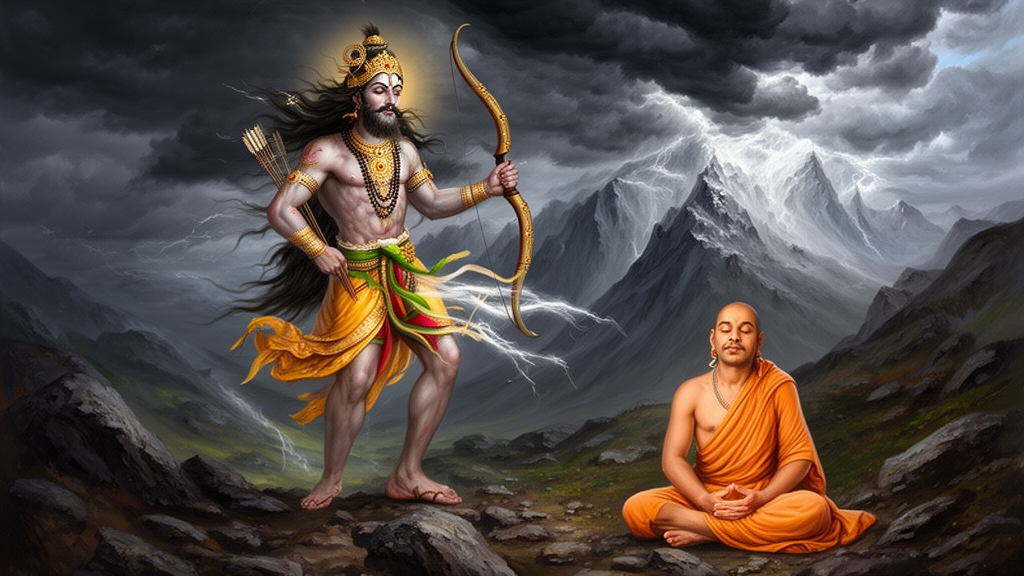
The summary describes the conclusion of the text as instruction on meditation. The Pranava, the syllable Om, is presented as a bow, and the seeker’s self as an arrow aimed at Brahman. The image appears in several Upanishads and is widely used in Hindu meditation traditions. In the Rudra Hridaya Upanishad, the summary says that this meditation unites the Atman with Brahman and leads to the realization of Sat-Chit-Ananda, usually rendered as existence, consciousness, and bliss.
Because the instruction is meditative and interior, it should not be turned into a checklist of guaranteed spiritual results. The text describes a path of knowledge and contemplation. Any claim that a practice produces a particular experience, status, or material benefit goes beyond what the text itself, as reported in the summary, can support. Teachers in different lineages give different guidance on how to practice Om meditation, including whether to begin with mantra recitation, breath, or study. Readers should follow a qualified teacher or tradition for practice.
Devotion, mantra, and the removal of sin
The summary also says the Rudra Hridaya Upanishad promotes devotion through the repetition of Rudra’s name and claims that this removes sins. This is a devotional statement that belongs to the text’s own world of belief. It should be presented as a teaching reported in the text or summary, not as a verified outcome. Hindu traditions speak in many ways about sin, penance, grace, and the effects of japa, and not all of them describe the removal of sin in the same way. A balanced article should describe what the text says and avoid promising specific results.
Role in the Shaiva tradition
The Rudra Hridaya Upanishad matters to students of Shaivism for several reasons. It presents Rudra as supreme, connects Shiva with the Upanishadic language of Brahman and Atman, and uses a dialogue form that makes its philosophy accessible. It also belongs to a larger body of texts that developed Shaiva ideas about devotion, knowledge, and liberation.
Shaivism itself is internally diverse. The Wikipedia article on Rudra lists several Shaiva and related denominations, including Kapalika and Pashupata, among others. These groups differ in ritual, theology, and practice. A reader should not assume that one text represents the views of all Shaivas. The Rudra Hridaya Upanishad is one expression of Shaiva thought, and its reception may vary by region, lineage, and teacher.
Interpretations across traditions
Devotional readings
For devotees of Shiva, the text can be read as a confirmation that Shiva is the highest reality and the inner self of all. Devotional readers may find comfort in its message that worship of one form is not a rejection of others. Such readings are important to the living tradition, even when they go beyond what a scholar would consider the original meaning.
Vaishnava and other readings
Because the text contains a unity teaching that places Vishnu and Brahma within the framework of Rudra, readers from other sampradayas may interpret it differently. Some may read it as a Shaiva affirmation of unity. Others may regard the hierarchy it presents as a view within Shaivism that they do not share. Neither reading needs to be presented as the only correct one. The respectful approach is to describe the text’s claims and note that other communities read Hindu sacred literature in their own ways.
Academic readings
Scholars approach the Rudra Hridaya Upanishad as a text with a manuscript history, a date of composition that is difficult to fix precisely, and a place within a complex literary tradition. The summary used here describes the text as medieval in era, and it cites a manuscript catalogue tradition. Scholars would usually want to see critical editions, manuscript variants, and dated references before making firm claims about origin. Any article that gives a single exact date without such evidence would be overstating what is known.
Manuscripts, dating, and what remains uncertain
Many Upanishads survive in multiple manuscript traditions. Variant readings, differences in verse order, and regional recensions are common. The summary mentions manuscript variations as a topic of discussion, but this research did not inspect a critical edition with an apparatus of variant readings. Readers who need to cite the text in academic work should consult an edition published by a reputable scholarly press or a university library, and should check the exact verse numbering and wording in that edition.
Dating is also uncertain. The summary calls the text medieval, but a precise century or decade would require more evidence than was available in this research. The safest statement is that the Rudra Hridaya Upanishad is a later Sanskrit Upanishad in the Shaiva tradition, and that its exact date and authorship should be treated as uncertain unless a specialist source provides evidence.
Practical reading guide
Readers who want to study the Rudra Hridaya Upanishad can approach it in stages. The first stage is context: learn the basic meaning of Upanishad, the role of Rudra and Shiva in the Vedic and Shaiva traditions, and the idea of Brahman and Atman. The second stage is structure: identify the dialogue between Suka and Vyasa, the invocations, the cosmic tree image, the pairing of Rudra and Uma, and the meditation on Om. The third stage is verification: compare the Sanskrit text and translation in a reliable edition.
- Start with a general reference on Rudra, such as the Wikipedia article on Rudra, to understand the name and its history.
- Read the Upanishad in a scholarly edition or translation that identifies its manuscript basis and verse numbering.
- Note which points come from the text, which come from a commentator or teacher, and which come from modern summaries.
- Compare the text with other Upanishads on Atman, Brahman, and meditation on Om before drawing broad conclusions.
For readers building a wider understanding of Upanishadic literature, the site’s related drafts include Rudra Upanishad, Kalagni Rudra Upanishad, and 108 Upanishad. These pages are WordPress drafts and may not yet be public, so their links should be checked before publication.
Common questions and misunderstandings
Is the Rudra Hridaya Upanishad the same as the Shri Rudram?
No. The Shri Rudram is a hymn devoted to Rudra, often associated with the Krishna Yajurveda and widely used in ritual contexts. The Rudra Hridaya Upanishad is a later philosophical text that presents Rudra’s supreme reality through dialogue and non-dual teaching. The two texts share a focus on Rudra, but they belong to different literary genres and periods.
Does reciting the text guarantee any result?
The text’s devotional teaching includes claims about the effects of devotion, including the removal of sin. These are teachings within the text’s own belief system. This article cannot verify any guaranteed spiritual, material, or health outcome, and readers should approach such claims as matters of faith and tradition rather than as proven facts.
Should every Hindu read this text in the same way?
No. Hindu communities differ in their scriptures, deities, rites, and philosophical emphases. The Rudra Hridaya Upanishad is especially important for Shaiva readers, but its reading may differ across lineages and teachers. Respectful study recognizes this diversity rather than treating one interpretation as universal.
Sources and evidence limits
This article was prepared from a limited research set. The Wikipedia article on Rudra was used for general background on Rudra as a Vedic storm deity, as an epithet of Shiva, and as a figure connected with the Rig Veda and Shri Rudram. The Grokipedia page on the Rudrahridaya Upanishad was used for the text’s classification, dialogue structure, and several doctrinal summaries. Grokipedia is a secondary and AI-generated reference page, so its claims should be checked against a critical edition or scholarly translation before being relied on in formal study. Video and streaming results found in the search set were not relevant and were not used as evidence.
Takeaway
The Rudra Hridaya Upanishad is a short Shaiva Upanishad that presents Rudra as the unifying reality behind the gods and the self. Its dialogue form, cosmic tree image, pairing of Rudra and Uma, and meditation on Om give it a distinctive voice within Upanishadic literature. The best way to read it is with both devotion and care: respect the tradition that treasures it, distinguish what the text says from later commentary and modern summary, and verify claims against reliable editions before drawing firm conclusions.
Sources and further reading
- Rudra, Wikipedia. Supports general background on Rudra as a Vedic storm and wind deity, an epithet of Shiva, and a figure linked with the Rig Veda and Shri Rudram. General reference only; not a primary source.
- Rudrahridaya Upanishad, Grokipedia. Secondary AI-generated summary used for classification, dialogue structure, and doctrinal summaries. Requires verification against a critical edition or scholarly translation.
Frequently asked questions
What is the main teaching of the Rudra Hridaya Upanishad?
The main teaching, as reported in the secondary summary, is that Rudra is the supreme reality and the inner self of all beings, and that liberation comes through non-dual knowledge rather than ritual alone.
Which Veda is the Rudra Hridaya Upanishad connected with?
The secondary summary places it with the Krishna Yajurveda. Readers should confirm this classification in a scholarly source before citing it formally.
Is there an English translation available?
This research did not verify a specific English translation. Readers should look for a reputable edition or translation through a university library, scholarly press, or established publisher.