The phrase On Holy Ground most often refers to On Holy Ground: A Daily Devotional by Dr. Charles F. Stanley, a Christian devotional book. It is not a Hindu scripture. This post explains what that book covers, notes that another book has the same title, and then compares the idea of sacred ground in Hinduism with the biblical image that gives the title its meaning.

What the On Holy Ground Book Is
Retail and library listings describe On Holy Ground as a daily devotional by Charles F. Stanley. Christianbook lists the ePub edition under the publisher Zondervan with a 1999 date, so readers should confirm the edition they are buying. Barnes & Noble and Google Books describe the book’s focus as an in-depth look at twelve biblical journeys, and they name three examples: Abraham leaving Ur for an unknown land, Jesus going into the wilderness of temptation, and Paul’s trip down the Damascus road.
The book’s own publisher and retailer descriptions present it as practical Christian teaching for daily encouragement. Its audience is Christian readers who use devotionals for personal reflection. Because this is the author’s interpretation of Bible passages, it should be read as a devotional commentary, not as a primary source for the biblical text.
Other books with the same title
Do not confuse Stanley’s book with On Holy Ground: Finding Your Story of Identity, Belonging, and Sacred Purpose by Keith R. Anderson and Linda L. Schubring, listed on Amazon under ISBN 9798385219216. That is a separate book with different authors and a different focus. Check the author name and ISBN before linking, quoting, or recommending either title.
Who Might Search for This Phrase
Readers who type "on holy ground book" into a search engine usually fall into three groups:
- Readers looking for the Stanley devotional and wanting to know its content and format.
- Readers who want to know whether the title is connected to Hinduism or another religion.
- Readers researching the broader idea of sacred ground, pilgrimage, and reverence for holy places across traditions.
This post addresses all three. The Stanley book is a Christian devotional; the rest of this article uses Hindu and biblical sources to explain sacred ground without merging the traditions.
The Biblical Image Behind the Title
The phrase "holy ground" comes from the Hebrew Bible, in the account of Moses and the burning bush in Exodus 3. In that narrative, God tells Moses to remove his sandals because the place where he stands is holy. Bible translations render the wording differently, so check the exact text in your chosen edition before quoting it. Christian interpreters have long read this scene as a lesson about God’s presence making a location holy, and about reverence as a physical response.
This is the Christian and Jewish reading of the Exodus narrative. Scholars also study its ancient Near Eastern background and its literary structure, which are separate questions from devotional meaning. A devotional like Stanley’s draws on this kind of passage for personal application, which is a different purpose from historical or textual scholarship.
Sacred Ground in Hindu Traditions
Hindu traditions have their own ways of describing sacred places. The Sanskrit word tirtha is commonly translated as a crossing place, ford, or sacred site, and it is used for places of pilgrimage, often at rivers, confluences, or sites linked to a deity or sage. Many pilgrims understand a tirtha as a place where the sacred is more accessible, but the meanings and practices attached to particular sites vary by region, community, and sect.
The Bhagavad Gita begins by naming the battlefield as dharmakshetra, a field of dharma, at Kurukshetra. The opening line is widely quoted in translations and commentaries. Readers should note that the Gita’s narrative setting is part of a dialogue about duty, not a statement about the land’s sanctity in a modern devotional sense. Commentators differ on how literally to read the place name. Check your chosen edition and commentary before making claims about the verse.
Pilgrimage in Hinduism is also shaped by local custom. A bathing ritual at one river, a temple circumambulation, or a visit to a forest shrine may be central in one community and unknown in another. Avoid presenting any single site or practice as universal.
Removing footwear and showing reverence
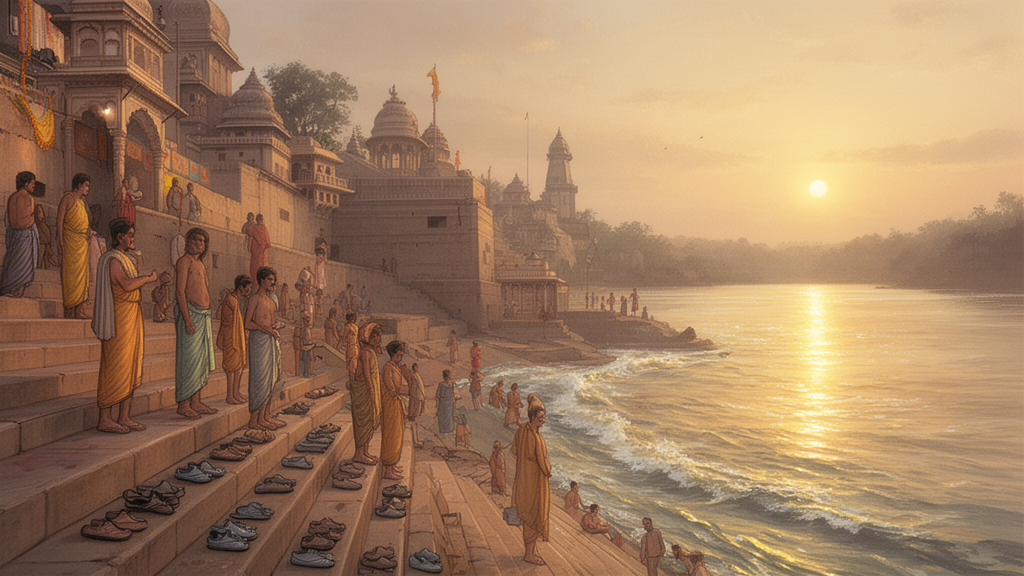
Many Hindu temples and homes ask visitors to remove footwear before entering sacred spaces. This is a widely observed sign of respect, similar in spirit to the Exodus image. However, the rule is not uniform. Practices vary by region, temple, and household, and some sites have different requirements. Follow the posted guidance at the specific place you visit.
Comparing the Ideas
The table below compares the concepts at a general level. It is not a full theology of either tradition.
| Topic | Biblical image (Exodus 3) | Hindu traditions |
|---|---|---|
| Source of holiness | God’s presence at the burning bush | Sacred associations of place, deities, sages, and tradition; interpretations vary |
| Common response | Removing sandals as a sign of reverence | Removing footwear in many temples and homes; other rules vary |
| Key term | "Holy ground" (translation-dependent) | Tirtha, dharmakshetra, and local sacred-site terms |
| Main text tradition | Hebrew Bible and Christian commentary | Vedic, epic, Puranic, and regional sources, with differing commentaries |
The comparison shows a shared human pattern: people mark some places as set apart and respond to them with restraint. It does not show that the traditions define holiness in the same way.
How to Read a Devotional Responsibly
Stanley’s book belongs to the devotional genre. Devotionals are designed for personal reflection and often combine scripture, interpretation, and application. They are valuable for their intended purpose, but they are not the same as a critical edition of the Bible or an academic history of the text. When a devotional makes a claim about the Bible’s meaning, it is the author’s reading.
The same principle applies to Hindu material. A retelling of a myth, a temple guide, and a scholarly edition of the Gita serve different purposes. Keep devotional belief, scripture, commentary, and historical evidence separate when you write or read about them.
Using This Topic on HindusGod.com
If you are exploring the Hindu side of sacred ground, start with the broader topic of holy books and how each tradition understands its own scriptures. The HindusGod.com draft pages below cover related questions; they are currently drafts, so the links may not be public until the owner publishes them:
- Holy Book, a general introduction to the term.
- Holy Book Meaning, on what the phrase signifies across contexts.
- Gita Holy Book, on how the Bhagavad Gita is treated as a sacred text.
- Geeta Holy Book, a related spelling and perspective on the same text.
- Holy Book in the World, on sacred texts across traditions.
- Best Holy Book, on how readers evaluate sacred texts.
- Hindi Holy Book, on Hindi-language sacred literature.
- Buddhist Holy Book, a comparison with another tradition.
- Daoism Holy Book, a comparison with a Chinese tradition.
- Avesta Holy Book, a comparison with Zoroastrian scripture.
Each of these links should be rechecked for live status before publication. They are not evidence for the claims in this article.
Frequently Asked Questions
Is On Holy Ground a Hindu book?
No. The Charles F. Stanley title is a Christian daily devotional based on biblical journeys. Hindu readers interested in sacred ground will find more relevant material in the Hindu traditions discussed above.
Who wrote On Holy Ground?
Retail and library listings credit Dr. Charles F. Stanley for the devotional. The Anderson and Schubring book with the same title is a different work.
Is the book based on scripture?
Yes, in the sense that its descriptions link it to biblical journeys such as Abraham, Jesus in the wilderness, and Paul on the Damascus road. The author’s commentary and application are his own interpretation.
Summary
"On Holy Ground" most often refers to Charles F. Stanley’s Christian devotional on twelve biblical journeys. Keep it separate from the Anderson and Schubring book with the same title. The phrase echoes the Exodus account of holy ground, and Hindu traditions have their own rich vocabulary for sacred places, including tirtha and dharmakshetra. Read each tradition on its own terms, check translations and local customs, and confirm sources before relying on any claim.
Sources and Further Reading
- Amazon listing: On Holy Ground: A Daily Devotional by Charles F. Stanley. Supports the title, author, and devotional format.
- Barnes & Noble: On Holy Ground: A Daily Devotional. Supports the description of twelve biblical journeys and the three examples named.
- Google Books: On Holy Ground. Supports the description of the book as biblical teaching for daily encouragement.
- Internet Archive: On holy ground : a daily devotional. Catalog record for the Stanley title.
- Christianbook: On Holy Ground ebook. Supports the Zondervan publisher and 1999 listing for that edition.
- Amazon listing: On Holy Ground: Finding Your Story of Identity, Belonging, and Sacred Purpose. Identifies the separate Anderson and Schubring book.