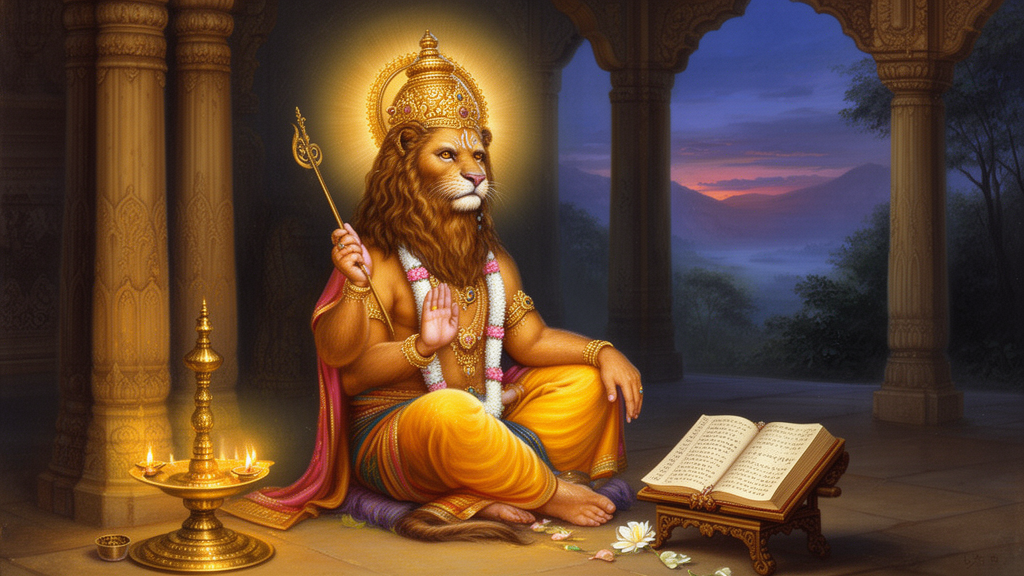
The Nrisimha Tapaniya Upanishad is a short Sanskrit text associated with Narasimha, the man-lion form of Vishnu. It is usually counted among the minor Upanishads linked to the Atharvaveda and is valued in Vaishnava devotion for its teachings on Om, the self (atman), Brahman, and meditative worship of Nrisimha. This guide explains what the text is, how it is organised, what it teaches, and how scholars and traditions read it. Where a claim comes from a particular source, the post says so.
What the Nrisimha Tapaniya Upanishad Is
The text is a Vaishnava Upanishad centred on Nrisimha. Wikipedia describes it as a minor Upanishadic text written in Sanskrit, linked to the Atharvaveda and divided into two parts, the Purva Tapaniya and the Uttara Tapaniya Upanishads [1]. The first part has five divisions and the second has nine chapters, according to the same summary [1].
Its main subject is Nrisimha, who is presented in the text as a form of Vishnu and as a source of protection. The Vyasa Mahabharata website summarises the text as asserting a fourfold identity: the self is the same as Om, Brahman is the same as the self, and Vishnu is identified with the man-lion avatar [5]. That summary is useful for orientation, but readers should treat it as an interpretive description and check it against a full translation.
The text also has a devotional and ritual dimension. Summaries describe the Nrisimha mantra and related hymns, which are called mantraraja, or king of hymns, and emphasise Om as the foremost syllable [5]. Whether and how these mantras are used in worship depends on the tradition and teacher.
Names, Spellings, and Title Variants
Readers will meet several spellings. The deity is written as Nrisimha, Nṛsiṃha, Narasimha, or Nrsimha. The second word is written as Tapaniya, Tapanīya, Tapini, or Tapani. The title is also given as Narasimha-tapani Upanishad and Nrisimhatapanopanishad, and one Sanskrit form is Nrsimhottara-tapaniyopanishat [5]. These spellings refer to the same tradition of texts, but library catalogues and online editions do not always use the same transliteration.
The title’s meaning is discussed in some summaries. The name Nrisimha combines nri or nara, meaning man or human, with simha, meaning lion [2]. The word tapaniya is often linked to the root tap, which can mean to heat or to burn, and to tapas, meaning austerity or spiritual discipline [2]. These etymologies are offered by a secondary summary, not by a critical edition, so they should be treated as explanatory rather than definitive.
Place in the Upanishadic and Atharvaveda Context
Upanishads are generally understood as philosophical and meditative texts that appear at the end of Vedic literature, though the body of Upanishads is large and uneven in date and character. The Nrisimha Tapaniya is one of the Upanishads that later tradition associates with the Atharvaveda [1][5]. Its link to the Atharvaveda is a traditional classification, and it does not by itself settle the text’s date or authorship.
Some summaries say the text is listed in the Muktika canon of 108 principal Upanishads [2]. That list is a traditional collection, and the text’s inclusion in it is best understood as a reported classification. For readers who want to explore the wider Upanishad family, the HindusGod posts on 108 Upanishad and 10 Upanishad give general orientation, though these pages are currently drafts and may not yet be public.
Its style and themes also connect it with other Vaishnava Upanishads. Wikipedia notes that the text is classified as Vaishnava [1]. Vyasa Mahabharata notes that its monist philosophy and style resemble other Vaishnava Upanishads, including those dedicated to Rama [5]. A reader interested in that comparison can begin with the draft post on the Rama Tapaniya Upanishad.
Date and Textual Origins
The date of the text is uncertain. Wikipedia gives a date before the 7th century CE [1]. Vyasa Mahabharata reports that Farquhar dates the text to before the 7th century CE because Gaudapada mentioned it, and that Lamb dates it to well before the 7th century [5]. These are scholarly positions reported by a secondary website. Readers should not treat any single date as settled without consulting the scholarly works cited in the references.
Grokipedia describes the text’s composition as dated before the 7th century by scholars such as Farquhar [2]. That summary matches the earlier references, but Grokipedia is an AI-generated encyclopedia and does not replace the primary scholarship. The honest position is that the text is traditionally and scholarly dated to a period before the 7th century CE, while its exact origin, compiler, and transmission history remain open.
The text’s authorship is also not established in the sources reviewed. Sanskrit Documents lists the text under the Atharvaveda and the Dashavatara category, with a Vedic author field in its metadata [3]. That listing shows where a digital edition is catalogued. It does not by itself establish the historical author of the Upanishad.
Structure: Purva and Uttara Tapaniya
The text is traditionally presented in two parts. Both parts are attributed to Nrisimha worship, but they differ in emphasis. Readers often find it easier to understand the Upanishad by following this division.
The Purva Tapaniya Part
According to Wikipedia, the first part is divided into five sections [1]. Grokipedia summarises it as praising Nrisimha as the supreme reality that pervades the Vedas and the elements, and as describing protective mantras, a Gayatri associated with Nrisimha, and a Sudarshana Chakra diagram used for elemental and visionary purposes [2]. These details are described in secondary summaries and should be checked in a full translation before being repeated as exact teachings.
Vyasa Mahabharata quotes a passage from the Purva Tapaniya section that begins with Om and describes it as encompassing past, present, and future, and what lies beyond time [5]. The passage is commonly cited as an example of the Upanishad’s emphasis on Om. A translation should be consulted for the exact wording.
The Uttara Tapaniya Part
The second part is described as having nine chapters [1][5]. Grokipedia says that this section moves toward deeper metaphysics, including the four states of consciousness commonly named jagrat, svapna, sushupti, and turiya, and the identity of the self with Om, also called Pranava [2]. Those four states are a familiar framework in Upanishadic thought, but the exact way the Uttara part develops them should be read directly in a critical translation.
Vyasa Mahabharata notes that the invocation and concluding hymns address Devas, Indra, the Sun, and Garuda as destroyer of evil, and that Brihaspati is invoked for health, prosperity, and peace [5]. These invocations show that the text belongs to a devotional setting in which Nrisimha worship sits alongside older Vedic deities.
Key Teachings: Om, Atman, and Brahman
The most consistently reported theme is the identity of Om, the self, and Brahman. Vyasa Mahabharata summarises the text as affirming that Atman is Om and that Brahman is Atman [5]. Wikipedia similarly says that the text is notable for a fourfold identity involving Atman, Om, Brahman, and Vishnu as the man-lion avatar [1][5].
For a general reader, a simple way to hold this idea is to see Om as the sound that represents the whole of reality, and the self as one with that reality in Vedantic thought. This is a philosophical interpretation and not a historical claim. Different schools of Vedanta and different Vaishnava traditions explain this identity in different ways. Some read it through non-dual Advaita, while Vaishnava teachers often interpret the relationship between self and supreme reality in ways that preserve devotional distinction. The Upanishad’s language allows both readings, so it is best to describe the teaching as one the text emphasises rather than as a single settled doctrine.
The HindusGod draft on the Advaita Upanishad may help readers compare non-dual readings, and the draft on the Adhyatma Upanishad covers the inner-self theme in other texts. Those pages are not yet public and should be checked before publication.
Mantras and Devotional Practice
The Nrisimha Tapaniya is often discussed as a source of mantras. The most cited is the Nrisimha mantra, which summaries describe as the mantraraja, or king of hymns, with four supplementary mantras [5]. Grokipedia also mentions protective mantras and the Nrisimha Gayatri [2]. These references describe the text’s contents. They do not, by themselves, prescribe a method of practice.
Devotional use varies widely. In some households, Nrisimha is approached through simple prayer, recitation on certain days, or temple worship. In other settings, mantra practice is taught by a guru and may involve initiation, specific counts, or specific preparations. Readers should not assume that a single method applies to all Vaishnava communities.
Some secondary summaries describe benefits that the text or its practices are said to bring, including wealth, fame, victory over enemies, and immortality [2]. These are claims reported from one encyclopedia summary and should be read as descriptions of what some devotional literature says, not as guaranteed outcomes. HindusGod’s editorial standard is to avoid promising material, health, or supernatural results. A devotee’s sincere practice is best understood within the tradition’s own framework of devotion and ethical living.
Practical Cautions for Readers
- Check mantra pronunciation with a qualified teacher or a reliable critical edition.
- Recognise that recitation practices differ among families, temples, and sampradayas.
- Treat secondary claims about benefits as reported beliefs, not proven results.
- Do not combine instructions from unrelated online sources without checking their origin.
Vaishnava and Nrisimha Traditions
The Nrisimha Tapaniya is classed as a Vaishnava text, and Wikipedia notes its importance in the Nrisimha sect of Vaishnavism [1]. Grokipedia describes it as a scriptural basis for tantric and devotional rituals that combine bhakti and jnana, though this claim is presented by a secondary summary and should be checked against specialist sources [2].
Nrisimha appears in many traditions beyond this Upanishad. He is commonly listed as the fourth of the Dashavatara, or ten principal avatars of Vishnu, and his story of protecting the devotee Prahlada is widely told in Puranic literature. The Upanishad is one text among many, and it should not be read as the only version of Nrisimha’s identity. For readers who want to see how Vaishnava texts treat avatars, the HindusGod post on the Ashtavakra Upanishad offers a contrast in a different sectarian and philosophical setting, though the two texts are not closely related.
Scholarly Views and Open Questions
The main open questions concern date, authorship, transmission, and the exact meaning of certain passages. Wikipedia reports that the century of composition is unclear [1]. Vyasa Mahabharata reports that Farquhar and Lamb place the text before the 7th century, using different reasons [5]. Those positions agree on an early date range but do not settle the question.
Scholars also distinguish between the text as a document, the tradition that uses it, and the devotional meaning that practitioners find in it. A Upanishad may be studied as literature, read as scripture in a community, or used as a source for ritual. These three approaches can overlap but should not be confused. A historical statement about a text’s date is different from a devotional statement about its power, and a philosophical interpretation is different from a ritual instruction.
Where sources disagree, this post follows the cautious approach. It reports the disagreement and does not select one view as universal. Readers who need a firm academic position should consult the critical editions and scholarly works listed below.
How to Read the Text Responsibly
A responsible reading begins with a critical edition or a translation that names its translator, notes its sources, and separates the text from commentary. Commentaries from later traditions, including the one associated with Vidyaranya, can be valuable, but they are interpretations and should be labelled as such. An archive listing for a Narasimha Purva Uttara Tapani Upanishad with a Sankarabhashya Dipika attributed to Vidyaranya shows that commentarial material exists in print and digital form [4]. The archive page was inspected for its metadata, and readers should confirm the edition’s details before relying on it.
Readers should also be aware of spelling variation. A search for one spelling may miss another, and online translations may differ in how they divide verses or name sections. Keeping a note of the edition, translator, and section number makes it easier to compare sources.
Examples of Where to Start
- Read a short introduction that explains the Purva and Uttara structure, such as the Wikipedia entry, and note which claims are cited [1].
- Compare a digital Sanskrit text with a reputable translation, checking whether the translator notes variant readings [3].
- Look at a commentary separately, and mark where the commentator offers an interpretation rather than a reading of the root text [4].
- Compare the Om teaching in the Purva part with the Uttara part’s discussion of the four states of consciousness, using a critical edition [2][5].
- Check any mantra or ritual instruction against a teacher or a reliable tradition before practising it.
Frequently Asked Questions
Is the Nrisimha Tapaniya Upanishad one text or two?
It is presented as one Upanishad in two parts, the Purva Tapaniya and the Uttara Tapaniya. Wikipedia describes the first part as having five divisions and the second as having nine chapters [1].
Is it a Vaishnava text?
Yes. Wikipedia classifies it as a Vaishnava Upanishad and notes its importance in the Nrisimha sect [1].
When was it written?
The text is generally dated before the 7th century CE, but the exact date is uncertain. Scholars cited in secondary sources offer different reasons for that date [1][5].
Does reading or chanting it guarantee a result?
No source reviewed supports a guaranteed material or supernatural outcome. Some summaries report benefits described in devotional literature, but those are beliefs and claims within a tradition, not verified results [2].
Summary
The Nrisimha Tapaniya Upanishad is a Sanskrit Vaishnava text centred on Narasimha. It has two parts, is traditionally linked to the Atharvaveda, and is usually dated before the 7th century CE. Its best-known teaching concerns Om as the sound of reality and the identity of the self with Brahman. Its mantras and devotional uses are important within Nrisimha worship, but readers should distinguish what the text says, what traditions believe, what scholars date, and what modern summaries claim. Start with a critical translation, check the claims against the sources below, and approach practice with a qualified teacher.
Sources and Further Reading
- Nrisimha Tapaniya Upanishad, Wikipedia: general description, classification, date range, and the two-part structure.
- Nrisimha Tapini Upanishad, Vyasa Mahabharata: summary of the fourfold identity, the Om passage, invocations, and dating views attributed to Farquhar and Lamb.
- Nrisimha Tapaniya Upanishad, Grokipedia: secondary summary of structure, mantras, and reported benefits; an AI-generated reference that should be checked against primary editions.
- Nrisinhatapini Upanishad, Sanskrit Documents: digital text listing with metadata placing it under the Atharvaveda and Dashavatara category; the full text was not inspected in this review.
- Narasimha Purva Uttara Tapani Upanishad with Sankarabhashya Dipika, Internet Archive: catalogue entry for a printed edition with commentary attributed to Vidyaranya; use it to locate commentarial material, not as proof of the root text’s date.