The Nada Bindu Upanishad is a short Sanskrit text of the minor Upanishads, classed as one of the Yoga Upanishads. It teaches meditation by listening inwardly to a subtle sound called nada, and by holding the mind on a single point called bindu. Its stated aim is moksha, understood in Vedanta terms as direct realization of the Self (atman). Hindi readers can find the text with Sanskrit, transliteration, and Hindi translation in several online editions, including the Vedapath edition cited below. This guide explains what the text teaches, how its key terms should be understood, where scholars and traditions differ, and how to approach the Hindi edition with care.

Direct answer: what the Nada Bindu Upanishad teaches
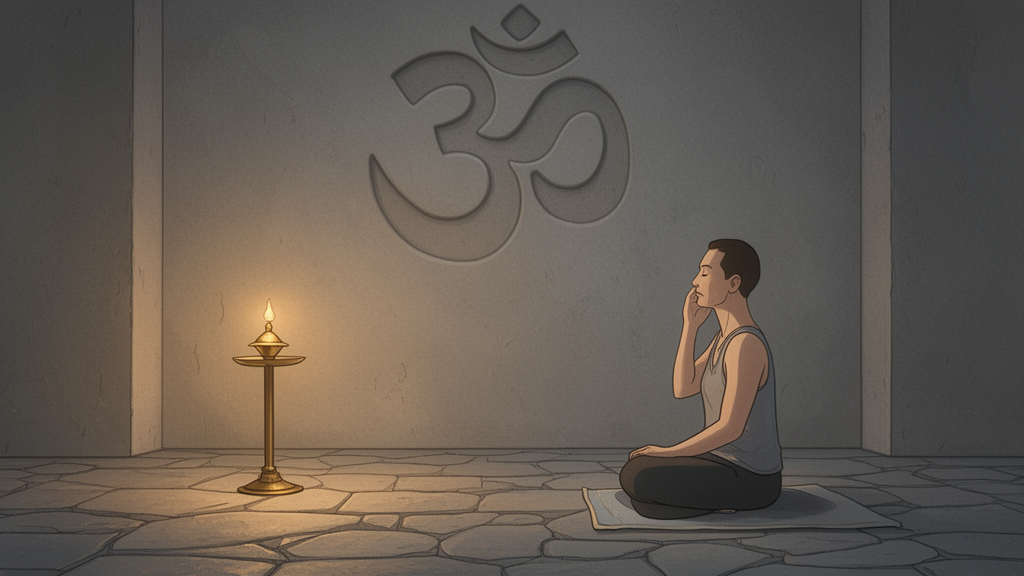
The Upanishad presents a path of inward concentration. The practitioner withdraws attention from outside objects and attends to a subtle inner sound. The text describes this sound as the primary support for meditation, and says that when the mind is steadied on it, mental activity gradually dissolves into stillness. Prāṇāyāma (regulated breath) and disciplined restraint of the mind are presented as supporting practices. The final aim is liberation, described as realizing the Self beyond names and forms.
This is a teaching about meditation and liberation. It is not a ritual handbook, and it does not describe a material benefit or a guaranteed outcome. Readers should treat its experiential claims as the text’s own teaching within the yogic tradition, not as a measurable result that a reader can expect on a fixed schedule.
Title, names, and language
The name is written नादबिन्दु उपनिषद् in Devanagari and Nādabindu Upaniṣad in IAST transliteration. Encyclopedic summaries explain that the title means something like ‘pinpoint concentration due to nada.’ The text is also known as the Amrita Nada Bindu Upanishad (अमृतनादबिन्दु उपनिषद), a variant name listed in the Wikipedia summary.
On HindusGod.com, readers may search for the title in several spellings. Common variants include Nada Bindu, Naad Bindu, and Nadabindu. They refer to the same text. Spelling does not change the meaning, but it matters when comparing editions. Hindi editions also differ in how they transliterate terms such as nāda and nād, so this article keeps the transliteration nada in English prose and uses Devanagari where the source uses it.
Readers who want the Hindi text should check the edition they are using. The Vedapath Hindi page presents 53 verses with Sanskrit, transliteration, and translation, while some encyclopedic and digital-library sources describe different verse counts. Those differences are explained in the next sections.
Key terms in context
Nada: the inner sound
In this Upanishad, nada refers to an inner, subtle sound rather than an audible sound produced by an instrument or voice. Encyclopedic summaries describe the Vedic term as the ‘unstruck sound’ or anahata nada, reported as a thin buzzing sound heard in the right ear by a meditator who attends to it. These descriptions come from secondary sources that summarize yogic and tantric traditions. They are experiential reports as they are presented in those traditions, not laboratory findings. Readers should treat them as traditional descriptions.
Anahata: the unstruck sound
The word anahata means ‘unstruck’ or ‘not beaten.’ Its use in yoga literature points to a sound that does not arise from two objects striking each other. The Wikipedia summary states that the Anahata sound is associated with the Anahata Chakra, which it describes as the fourth chakra in Vedic terminology. The chakra system is a later and widely used yogic framework, so readers should note that this association belongs to the yogic tradition and is not a claim the Upanishad itself has to make in the same vocabulary.
Bindu: one-pointed focus
The Vedapath page describes bindu as a seed-point of consciousness, where concentration becomes one-pointed and mental modifications settle. The word literally means a drop or point. In this text, the emphasis is on focus rather than on a physical location. The page’s commentary frames the teaching as attention narrowing until the distinction between the meditator, the act of meditating, and the object of meditation fades.
Turya and the stages of meditation
The Wikipedia summary says that a meditator who attends to the sound attains turya, the ‘fourth’ state beyond waking, dream, and deep sleep, more easily. Turya is an important term in Upanishadic and Advaita writing, but the exact meaning in this text should be read in the wider Upanishadic context. This article does not assume a single definition.
Prāṇāyāma and moksha
Prāṇāyāma is breath regulation, and the Vedapath summary presents it as a means to steady prāṇa, the vital energy or breath, so that the mind can become quiet. Moksha is liberation from the cycle of rebirth. In the Vedanta reading summarized by the Vedapath page, moksha means direct realization of the Self, beyond names and forms.
Date, attribution, and scholarly views
The date of the Nadabindu Upanishad is uncertain. Scholars have proposed different ranges, and no single date is settled. The Wikipedia summary reports the following positions:
- Gavin Flood dates this text, along with other Yoga Upanishads, to probably between about 100 BCE and 300 CE.
- Guy Beck dates it to probably the pre-Christian era, and describes it as the earliest document on the yoga of sacred sound.
- Georg Feuerstein suggests a period in the early first millennium CE.
- Mircea Eliade places it chronologically with the ancient Yoga Upanishads, composed in the same period as texts such as the Maitri Upanishad.
These are scholarly estimates, not dates recorded in the text itself. A reader who sees a single exact year should treat it with caution. The honest position is that the Upanishad belongs to a broad early period of Upanishadic composition, and that the range depends on the scholar, the criteria used, and the manuscript evidence considered.
Which Veda is it attached to?
Traditional and academic accounts also differ about the Veda to which the text is attached. The Wikipedia summary states that the text exists in two significantly different versions, the North Indian and the South Indian. The North Indian version is attached to the Atharvaveda, and the South Indian version to the Rigveda. The Vedapath page lists the text under the Atharva Veda. The Sanskrit Documents metadata, which appeared in search results and was not separately fetched for this article, describes the file as belonging to the Rig Veda Yoga Upanishad group. Readers should therefore say ‘attached to the Atharvaveda in one recension and the Rigveda in another’ rather than giving one Veda as the sole answer.
The structure of the text
Verse counts and editions
The Nadabindu Upanishad has no single verse count in every source. The Wikipedia infobox lists 20 verses in one place and 56 in another. The Vedapath edition presents 53 verses. Sanskrit Documents lists the work in its digital collection without repeating a count in the metadata that was checked. These numbers reflect differences in recensions, editions, and numbering systems. A reader comparing an edition with this article should first check the edition’s own numbering.
The opening: Om and its parts
The Vedapath Hindi edition opens with a verse on the syllable Om. Its first verse, as presented in that edition, describes the letter a as the right wing, u as the left wing (in the edition’s translation, the upper side), and m as the tail, with the half-mātrā (the silent end of the syllable) as the head. The edition labels this verse with Brahman, meaning the praṇava, or Om, as a symbol of Brahman. This is an edition-based summary and is not a standalone claim about all Om teaching in Hinduism.
This opening is useful for readers because it shows the method of the text. It uses a familiar sacred syllable, breaks it into parts, and then uses those parts as a path for contemplation. Many Upanishads use such symbolic structures. The Nadabindu Upanishad places this symbolism within a yogic practice of inner hearing.
Cosmic correspondence in the middle verses
The Vedapath summary of verses 3 and 4 describes a correspondence between the body and cosmic worlds. It locates the lower worlds at the feet and knees, the middle worlds at the waist and navel, and higher worlds in the heart, throat, and forehead, ending with the highest world at the center of the forehead between the brows. This is a microcosm and macrocosm teaching. It presents the body as a model of the universe. Readers should note that these correspondences are part of the text’s symbolic system, not a physical description.
Mantra and the thousand-syllable formula
The Vedapath commentary on the early verses refers to a mantra with a thousand syllables. It also describes the first and second mātrās as fire-like and air-like, and the later mātrās as shining like the sun’s disc. The commentary links these to purification through mantra and to the meditator who is steady in hamsa yoga. Because these verses use dense symbolic language, readers should consult a scholarly or teacher-guided translation before drawing conclusions about their literal meaning.
Core teachings of the Upanishad
1. Attention to inner sound
The central practice is to listen inwardly. The Vedapath summary describes a progression from gross perception to subtle sound, and from subtle sound to a state of silence in which the sound is no longer heard as separate from the listener. This is the core of the text’s yoga. It teaches that the mind can be led inward through attention, rather than through force.
2. Breath and restraint
The text pairs listening with the steadying of breath and the restraint of the senses. The Vedapath summary states that the Upanishad integrates prāṇāyāma with meditative absorption, and that discipline and sustained practice are prerequisites for stable samādhi. A reader who wants to apply these teachings should not treat them as a substitute for qualified instruction in breath practices. Breath techniques can be intense, and traditions differ on how and when they should be practiced.
3. Interiorization
The Vedapath summary describes progressive interiorization. The mind moves from outer objects to inner sound and then to the stillness that the text associates with nirvikalpa-like absorption. This progression is a teaching about the structure of meditation. It is not a promise that every practitioner will reach each stage.
4. Mokṣa as realization
The final aim, as presented in the Vedapath summary, is mokṣa understood as the direct realization of the Self beyond names and forms. This is a Vedantic goal, and different Hindu traditions describe it differently. Dvaita, Vishishtadvaita, and Advaita schools, for example, interpret the relation between the individual self and Brahman in different ways. The Nadabindu Upanishad’s own language is closest to the non-dual vocabulary of the later Upanishads, but readers should not assume that all schools would describe liberation in the same terms.
Scripture, tradition, and scholarship
It helps to separate four kinds of statements when reading this Upanishad:
- What the text says: For example, that inner sound is a support for meditation, and that prāṇāyāma steadies the mind. These statements come from the Upanishad as presented in the edition being read.
- Traditional belief and interpretation: For example, that the Anahata sound has a source in the Anahata chakra, or that a meditator hears a buzzing in the right ear. These are beliefs and experiential accounts reported within yoga traditions.
- Historical evidence and scholarly interpretation: For example, the date ranges proposed by Flood, Beck, and Feuerstein, and Eliade’s chronological placement. These are academic positions, and they disagree.
- Modern devotional or practical explanation: Teachers and websites often add their own guidance. Such material should be labelled as commentary, not as the Upanishad itself.
Mikel Burley, as summarized on Wikipedia, notes that this text does not provide the techniques of Hatha Yoga, although it may have influenced later Hatha Yoga texts. This is a useful caution. Readers who expect a detailed posture manual will not find one here. The text is focused on sound, breath, and absorption.
How the text is listed and collected
The Upanishad appears in several traditional lists. The Vyasa Mahabharata page reports that it is number 38 in the Muktika enumerated by Rama to Hanuman, in the modern anthology of 108 Upanishads. It is number 17 in Colebrooke’s list of 52 Upanishads, which was popular in north India, and number 17 in the Narayana anthology in the Bibliotheca Indica. The same page also notes a collection titled Oupanekhat compiled under Sultan Mohammed Dara Shikhoh in the 17th century. These lists show how the text was circulated and grouped. They do not establish the text’s date or original form.
A practical way to read the Hindi edition
Readers who use a Hindi edition can follow a simple reading method that respects both the text and the tradition.
- Read the Sanskrit and transliteration first, if you can. Hindi translations are helpful, but they are interpretations. Compare terms such as nada, bindu, and prāṇa across at least two translations.
- Note the edition details. Record the publisher, the verse numbering, and whether the text follows an Atharvaveda or Rigveda recension.
- Separate the verse from the commentary. Many Hindi pages include a summary or theme label beside each verse. These labels are useful, but they are not part of the Sanskrit text.
- Read it slowly and in a quiet setting. The text is short, and its themes are meditative. Reading it in one sitting makes the sequence harder to follow.
- Seek qualified guidance for practice. Breath and meditation instructions are tradition-specific. A teacher within a lineage, or a published commentary by a recognized scholar, is a better guide for practice than a general online summary.
This approach helps the reader distinguish the Upanishad’s teaching from later explanations, and from the many devotional or commercial claims that circulate online.
Common misunderstandings
Is it only about music or sound healing?
No. The text uses sound as a meditative object, not as a therapy. Modern sound-healing practices may draw on the idea of inner sound, but the Upanishad itself centers on absorption and liberation. Any health claim that links the text to a specific physical outcome goes beyond what the sources support.
Does reading the text guarantee an experience?
No. The text describes a path and its stages, but it does not promise a fixed result. Traditional descriptions of experiences, including the buzzing sound, are reports within a practice tradition. They are not measurable guarantees.
Is there one correct Hindi version?
No single Hindi edition is the only correct one. Translations vary in vocabulary, verse division, and commentary. Readers should compare editions and attribute each translation to its translator or publisher.
Related reading on HindusGod.com
The following pages are current WordPress target drafts on HindusGod.com. They may not be public yet, so readers should treat these links as future references until the owner publishes them:
- The All Upanishad in Hindi page offers an overview of the Upanishads in Hindi, useful for placing this text among others.
- The Dhyan Bindu Upanishad in Hindi page covers another short Yoga Upanishad that also focuses on meditative concentration.
- The Dhyan Bindu Upanishad page provides a companion view of the same meditative theme.
- The Bindu Upanishad page is useful for readers who want to explore the bindu concept in another Upanishad.
- The Amritabindu Upanishad in Hindi page covers a related Yoga Upanishad with a similar title element.
- The Amrita Bindu Upanishad page explains a text that shares the Amrita element found in one name of the Nadabindu Upanishad.
- The Brahma Bindu Upanishad page covers another early Yoga Upanishad listed alongside the Nadabindu in Eliade’s chronology.
- The Kaivalya Upanishad in Hindi page offers a Hindi reading on liberation and the Self.
- The Nada Bindu page is a related draft on the same sound-and-point theme.
- The Brihadaranyaka Upanishad Hindi page places the Upanishadic tradition in a broader context of major Upanishads.
Note for the owner: a separate draft, Nada Bindu Upanishad, and another draft, Naad Bindu Upanishad in Hindi, target the same or very similar search intent. They were not linked in this body to avoid internal cannibalization. The owner should decide which page should be the canonical destination before publishing.
Frequently asked questions
What is the Nada Bindu Upanishad about?
It is a Yoga Upanishad about meditation on inner sound (nada) and one-pointed concentration (bindu), with the aim of realizing the Self and attaining liberation. It also includes breath regulation and the restraint of the mind.
Is it written in Hindi?
The original text is in Sanskrit. Hindi editions, such as the Vedapath page, provide Sanskrit, transliteration, and Hindi translation, with summaries. The Hindi is a translation or interpretation, not the original text.
How many verses does it have?
Sources differ. The Vedapath edition presents 53 verses, while encyclopedic summaries list different counts. The number depends on the recension and edition.
Is it a manual for hatha yoga postures?
No. According to Mikel Burley, as summarized on Wikipedia, the text does not provide hatha yoga techniques, although it may have influenced later hatha yoga texts. Its emphasis is on sound, breath, and absorption.
Summary and next step
The Nada Bindu Upanishad teaches that the mind can be drawn inward by attending to a subtle inner sound, steadied on a single point, and supported by breath discipline. Its goal is mokṣa, understood in Vedantic terms as realization of the Self. Its date and Veda attachment are debated, its verse count varies by edition, and its meditation practices should be learned within a qualified tradition. For Hindi readers, the best next step is to compare two or three Hindi editions, note their verse numbering, and read the Sanskrit alongside the translation where possible.
Sources and further reading
- Nadabindu Upanishad, Wikipedia: used for the summary of dates proposed by Flood, Beck, Feuerstein, and Eliade, the North and South Indian versions, the Anahata sound description, the Burley comment on hatha yoga, and the verse-count discrepancy.
- Naadbindu Upanishad in Hindi, Vedapath: used for the Hindi edition’s verse count (53), the key teachings summary, and the summary of verse 1 and verses 3 and 4 as presented in that edition.
- Nadabindu Upanishad, Vyasa Mahabharata: used for the Muktika number (38), Colebrooke list (17), Narayana anthology (17), and the Oupanekhat note.
- Nadabindu Upanishad, Sanskrit Documents: used only for its transliteration and digital-collection metadata, based on search-result text. The page was not fetched in full for this draft, so readers should verify the Sanskrit text there directly.